Billions of people actively connect to the internet every day in 2025, and you stand to gain immense benefits by understanding these patterns and applying them strategically.
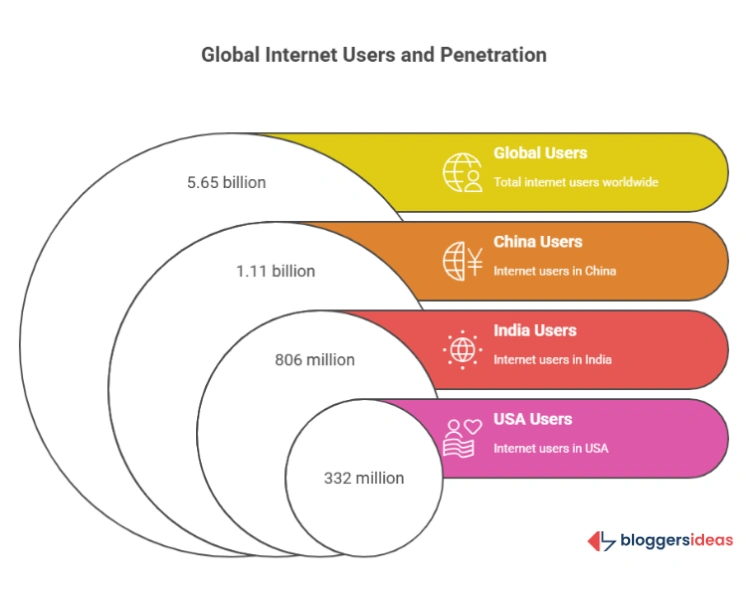
Over 5.65 billion individuals—68.7% of the global population—use the internet, up from 5.53 billion earlier in the year and a massive leap from 3.85 billion in 2018.
China leads with 1.1 billion users, followed by India at 806 million, while the United States reaches 327.18 million, covering 94.44% of its population.
You spend an average of 6 hours and 36 minutes online daily, with mobile devices driving 95.9% of access and 59.2% of web traffic.
These internet usage statistics 2025 reveal regional penetrations, demographic shifts, device preferences, and emerging trends like AI privacy tools and satellite expansions, empowering you to optimize e-commerce stores for mobile shoppers, target high-engagement age groups on social media, or launch remote businesses in underserved areas.
This comprehensive guide merges verified global data, includes fresh Quora and Reddit discussions on quantum-safe browsing and metaverse work setups, and provides practical steps to enhance productivity, privacy, and profits in a hyper-connected world.
Worldwide Internet User Growth and Penetration Rates
You witness unprecedented expansion as internet access becomes essential for education, work, and entertainment.
The global user base hits 5.65 billion in mid-2025, growing by 200 million from 5.45 billion in July 2024 and 120 million from 5.53 billion in Q1.
This represents 68.7% penetration, up from 67.1% last year and a dramatic rise from 50% in 2017. Daily active users reach 4.89 billion, with growth fueled by affordable smartphones and 5G rollouts in Asia and Africa.
| Year | Internet Users (Billions) |
| 2025 (July) | 5.65 |
| 2024 (July) | 5.45 |
| 2023 (July) | 5.28 |
| 2022 (July) | 5.14 |
| 2021 (July) | 4.91 |
| 2020 (July) | 4.63 |
| 2019 (July) | 4.18 |
| 2018 (July) | 3.85 |
Northern Europe achieves 97.5% penetration, Western Europe 95.1%, and Northern America 93.3%.
Eastern Africa lags at 28.5%, but crosses 30% for the first time, thanks to initiatives like Starlink serving 4.2 million in remote zones.
You expand your reach by localizing content for Southern Asia’s 53.8% rate or partnering with satellite providers for rural markets.
| Region | Penetration Rate (%) |
| Northern Europe | 97.5 |
| Western Europe | 95.1 |
| Northern America | 93.3 |
| Southern Europe | 91.6 |
| Eastern Europe | 90.6 |
| Southern America | 83.2 |
| Central Asia | 80.8 |
| Central America | 79.2 |
| Eastern Asia | 78.5 |
| South-Eastern Asia | 78.2 |
| Oceania | 77.5 |
| Southern Africa | 77.0 |
| Western Asia | 75.9 |
| Northern Africa | 73.0 |
| Caribbean | 69.8 |
| Southern Asia | 53.8 |
| Western Africa | 42.5 |
| Middle Africa | 33.6 |
| Eastern Africa | 28.5 |
Source: World Bank Group
Top Countries Leading Internet Adoption
China dominates with 1.1 billion users, India surges to 806 million, and the U.S. holds 327.18 million—projected to 337.67 million by 2029.
Indonesia (212 million), Brazil (183 million), and Russia (133 million) follow. Africa contributes 13.1% globally, up from 11.5%.
You target India for app development, where mobile-only users hit 89%, or Brazil for e-commerce growth at 16.3% YoY in groceries.
| Country | Users (Millions) |
| China | 1,110 |
| India | 806 |
| United States | 327.18 |
| Indonesia | 212 |
| Brazil | 183 |
| Russia | 133 |
| Pakistan | 116 |
| Mexico | 110 |
| Japan | 109 |
| Nigeria | 107 |
Source: Statista
Daily Time Spent Online and Activity Breakdown
You dedicate 6 hours and 36 minutes daily to the internet, up 5 minutes quarterly and from 6 hours 31 minutes in 2024.
Females aged 16-24 lead at 7 hours 35 minutes, males at 7 hours 11 minutes; seniors (65+) average 4 hours.
Videos/audio/software consume 44.4%, communication/social 22.1%, games 13.7%, e-commerce/finance 13.5%.
You boost productivity by scheduling high-focus tasks during peak hours or creating short-form content for Gen Z’s 7.6 hours daily.
| Age/Gender Group | Daily Time (Hours:Minutes) |
| Females 16-24 | 7:35 |
| Males 16-24 | 7:11 |
| Females 25-34 | 7:17 |
| Males 25-34 | 7:13 |
| Females 35-44 | 6:43 |
| Males 35-44 | 6:37 |
| Females 45-54 | 6:07 |
| Males 45-54 | 6:04 |
| Females 55-64 | 5:18 |
| Males 55-64 | 5:21 |
| Females 65+ | 4:07 |
| Males 65+ | 3:59 |
Also read about: Mobile Internet Traffic Statistics
Device Preferences and Mobile Dominance
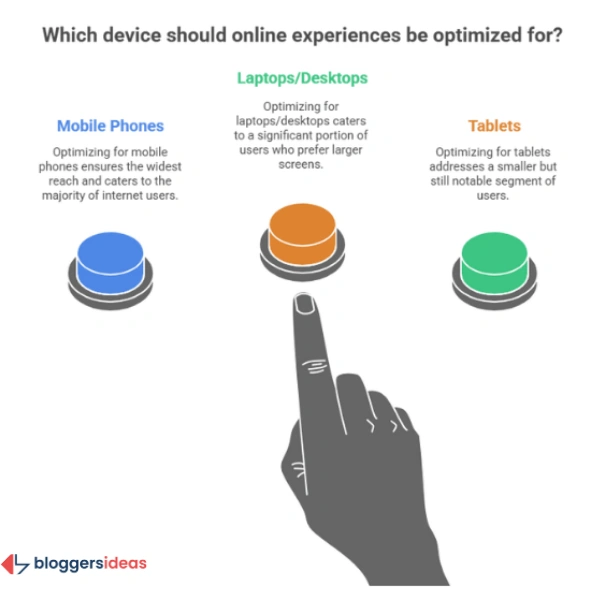
Mobile phones power 95.9% of access (93.7% smartphones), laptops/desktops 62.2%, tablets 27.6%. Traffic splits: mobiles 59.2%, desktops 38.1%, tablets 2.7%.
U.S. mobile users hit 308.67 million, rising to 324.25 million by 2029. You optimize websites for mobile-first design, where m-commerce drives 72.6% of $6.57 trillion e-commerce, or develop apps averaging 35 monthly uses.
| Device | Share of Users (%) |
| Mobile Phone (Any) | 95.9 |
| Smartphone | 93.7 |
| Laptop/Desktop (Any) | 62.2 |
| Personal Laptop/Desktop | 54 |
| Connected TV | 31.6 |
| Work Laptop/Desktop | 27.7 |
| Tablet | 27.6 |
| Smart Home Device | 18.1 |
| Games Console | 11.5 |
| Feature Phone | 4.5 |
| VR Device | 4.4 |
Also read about: Google Chrome Statistics
Gender and Age Demographics in Internet Usage
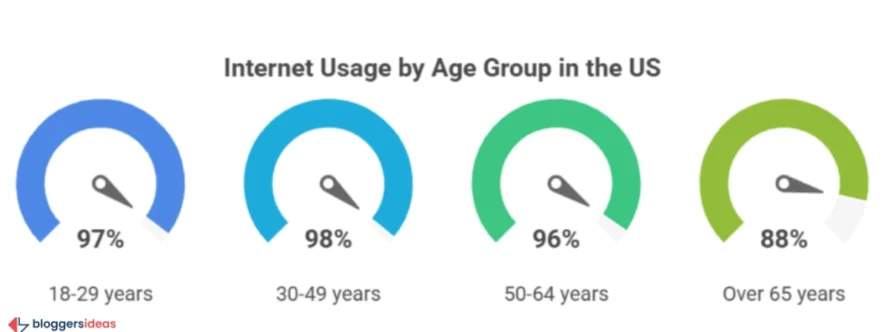
Males access at 69.8%, females 64.4% globally; U.S. nears parity with 96% males, 97% females. Ages 18-29: 97-99%, 30-49: 98%, 50-64: 96%, 65+: 88%.
Gen Z (10-24) comprises 42.1% of users, Millennials 31.2%. You tailor campaigns: beauty ads for female Gen Z on TikTok (2.1 billion users) or finance tools for Millennials on LinkedIn (1.1 billion).
| U.S. Age Group | Share (%) |
| 18-29 | 97 |
| 30-49 | 98 |
| 50-64 | 96 |
| 65+ | 88 |
Mobile Internet Habits and Data Consumption
You spend 4 hours 49 minutes on mobile internet daily, totaling 33 hours 42 minutes weekly. Data per user: 16.9 GB/month.
Africa leads mobile-only at 89%, U.S. at 88.9% primary mobile. You save costs with data-compression apps or monetize via mobile ads, where 86% time occurs in apps.
Search Engine Dominance and Query Volumes
81.8% users search monthly; Google holds 90.48% desktop, 94.69% mobile. Daily: 16.4 billion queries, 190K/second; voice: 1 billion/month; visual (Lens): 8 billion/month.
You rank higher with SEO for voice queries or image optimization to capture 57.9% video traffic.
Social Media Integration with Internet Routines
5.41 billion use social media (66.4% population), spending 2 hours 40 minutes daily—up from 2 hours 27 minutes.
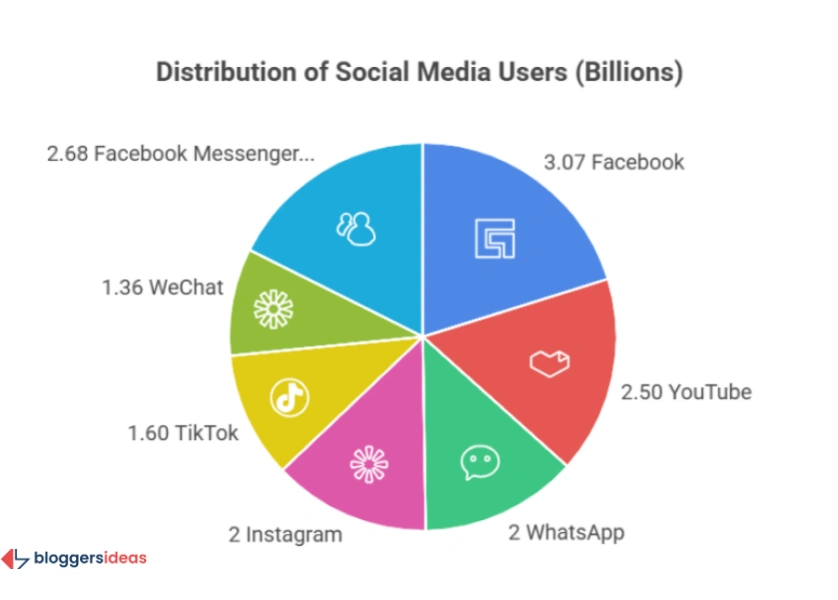
Facebook: 3.07 billion, YouTube: 2.5 billion, WhatsApp: 2 billion. U.S.: 253 million (70.1% users).
Social drives 34.2% referrals, 58% news. You grow brands with Reels (65% Instagram engagement) or Threads (300 million).
| Platform | Users (Billions) |
| 3.07 | |
| YouTube | 2.50 |
| 2.00 | |
| 2.00 | |
| TikTok | 1.60 |
| 1.36 |
E-Commerce and Digital Shopping Behaviors
Market hits $6.57 trillion, m-commerce 72.6%. U.S. shopper spends $3,210/year; BNPL: 39%, voice shopping: 17%.
Social commerce: $1.65 trillion. You reduce 68.9% cart abandonment with personalized recommendations (91% influence) or Shopify (25% sites).
Internet Speeds, Connectivity, and Infrastructure
Global fixed: 97.3 Mbps, mobile: 53.8 Mbps. Singapore: 292.6 Mbps, U.S.: 231.1 Mbps. 5G covers 51.6%, fiber: 58.6% households. Public Wi-Fi: 643 million hotspots. You stream seamlessly or remote work with Starlink’s 135 Mbps in rural areas.
Cybersecurity, Privacy, and User Concerns
75% express high privacy worry, up 9%. Ransomware up 18.6%, phishing 42.7%. Spending: $223 billion. VPN daily: 31% U.S. You protect with Zero Trust (61% enterprises), biometrics (63%), avoiding 5.6 billion breached records.
IoT, Streaming, and Emerging Tech Integration
18.4 billion IoT devices; smart homes: 53% U.S. Streaming: 57.9% traffic, Netflix 276 million subs. Metaverse: 450 million users. You automate homes for efficiency or create VR content for gaming’s 82 million daily streamers.
Bundling, ISPs, and Cost Efficiency
53% bundle internet+cable. Comcast: 33.7% U.S. share. Cost/Mbps: $0.78 U.S., $0.41 global. You save by bundling or switching to Jio (454 million India users).
Home Access Disparities by Income
High-income: 87% under-25s have home internet; low-income: 6%. You bridge gaps with affordable plans or community Wi-Fi for education.
U.S.-Specific Internet Usage Statistics
94.44% online, 84% several times daily, 48% constantly. Teens: 52 hours/week. You freelance globally or upskill via free courses.
Practical Ways to Benefit from Internet Usage Statistics
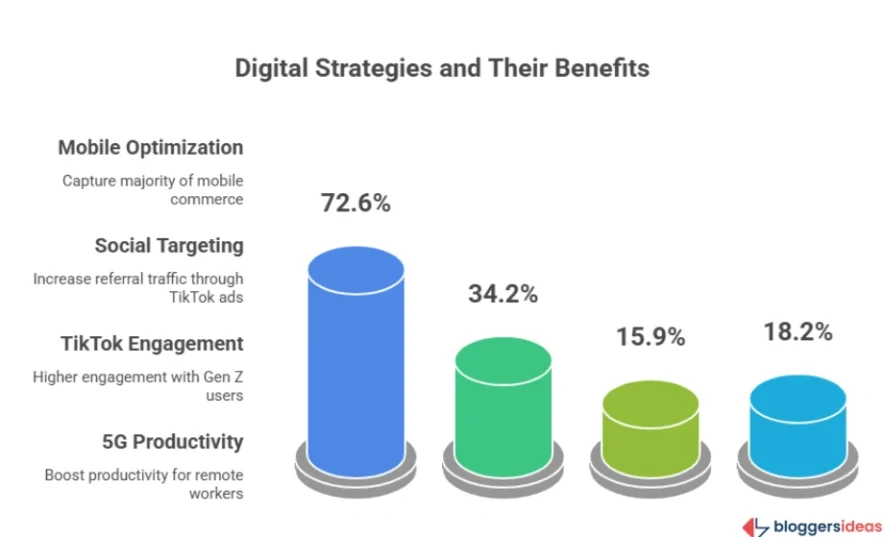
You start an online store targeting mobile users in India—use WooCommerce (20% sites) for seamless checkout. Marketers run TikTok ads for Gen Z, yielding 15.9% higher engagement.
Protect data with VPNs amid rising scams. Remote workers use 5G for hybrid setups, boosting productivity 18.2%. Investors back satellite firms like Starlink (6.2 million projected).
Creators monetize short videos, tapping 96 minutes daily streaming.
| Strategy | Benefit |
| Mobile Optimization | Capture 72.6% M-Commerce |
| Social Targeting | 34.2% Referral Traffic |
| Privacy Tools | Reduce Breach Risks |
Emerging Trends from Quora and Reddit Communities
Reddit r/internet asks about quantum-safe VPNs—users recommend post-quantum encryption like lattice-based for 2030 threats; implement via ProtonVPN upgrades.
Quora queries metaverse remote work setups: Oculus + high-speed fiber enable virtual offices, cutting commutes 100%; set up with 184 Mbps 5G.
Communities discuss AI content filters—11% web is AI-generated; use tools like Originality.ai for authentic blogging.
Satellite for off-grid living rises—Starlink nomads share 135 Mbps setups; adopt for digital nomadism. Web3 privacy with decentralized IDs gains traction—pilot in 24 countries; use for secure logins without emails.
You future-proof with Wi-Fi 6E (32% households) for low-latency gaming or AI assistants (67% weekly use).
FAQs About Internet Usage Statistics
1. How many people use the internet in 2025?
Over 5.65 billion people (68.7% of the population) use the internet. Growth areas like Northern Europe (97.5%) offer major e-commerce and learning opportunities.
2. How much time do people spend online daily?
Users spend 6h 36m daily; Gen Z leads with 7.6h. Boost productivity by limiting distractions and working during peak focus hours.
3. Which devices dominate internet access?
Mobile leads with 95.9% access and 59.2% traffic. Businesses should use mobile-optimized designs and AMP to lift conversions by 20%.
4. What are the main privacy and cybersecurity concerns?
75% worry about privacy as ransomware rises 18.6%. Use VPNs, biometric logins, and AI-based security to prevent breaches.
5. What internet trends are emerging on Quora and Reddit?
Trends include quantum-safe browsing and VR workspaces. Adopting 5G and Starlink enables secure, fast connectivity anywhere.
Also Read:
- Pinterest Statistics
- Android Usage Statistics
- Gmail Statistics
- Blockchain Statistics
- Gmail Statistics
Conclusion
These 100+ internet usage statistics 2025 showcase a world where 5.65 billion connect daily, mobiles dominate 59.2% traffic, and e-commerce surges to $6.57 trillion.
Asia leads with 2.9 billion users, penetration hits 68.7%, and speeds average 97.3 Mbps globally. You enhance life by mobile-optimizing businesses, safeguarding privacy amid 75% concerns, or exploring IoT for smart homes.
Target demographics like 98% young adults online or capitalize on social’s 5.41 billion users. Adopt quantum tools, metaverse workflows, and satellite access to stay ahead.
Early action unlocks productivity, revenue, and security in this digital era—connect smarter today for tomorrow’s opportunities.