Here is an uncomfortable truth most GoDaddy SSL reviews skip. For the vast majority of websites, an SSL certificate should cost exactly zero dollars. Let’s Encrypt, Cloudflare, and most modern hosts hand out encryption for free, automatically, forever.

GoDaddy SSL certificates provide domain validation and encryption protection for websites, available in Standard, Wildcard, and Multi-Domain varieties with 24/7 support and up to $10,000 warranty coverage.
Pros
- Steep first-year discounts with GoDaddy SSL coupon codes dropping Standard certificates to $17-$30 annually, making initial purchase affordable.
- Multiple certificate types covering Standard, Wildcard, and Multi-Domain options to protect single domains, subdomains, or multiple sites.
- Easy installation with straightforward setup wizards and compatibility across all major hosting providers and server types.
- Reliable validation with quick domain verification turnaround enabling fast certificate issuance and immediate site protection.
- 24/7 customer support available through chat, phone, and email to assist with certificate issues and troubleshooting.
Cons
- Limited advanced features compared to premium certificate providers, lacking extras like advanced warranty or priority support.
- Free alternatives available like Let's Encrypt provide identical security at zero cost, eliminating need to pay GoDaddy after initial term.
starting with $5.99/mo
Get Started with Godaddy SSLSo why does GoDaddy still sell SSL certificates starting around $70 per year, and why do people keep buying them? More importantly, should you?
I dug into GoDaddy’s 2026 SSL lineup, compared it honestly against free options and cheaper paid rivals, and mapped out exactly who actually needs a paid certificate. This GoDaddy SSL review gives you the answer without the marketing fog.
Quick GoDaddy SSL Certificate Review Overview
A concise snapshot of GoDaddy SSL certificate types, pricing structure, and key features for fast understanding in this comprehensive GoDaddy SSL certificate review.
Item | Details |
What it is | Commercial SSL certificates from the world’s largest domain registrar |
Parent company | GoDaddy, founded 1997 |
Entry price | Around $69.99 per year (single domain DV) |
Managed DV | Around $9.99 per month |
Wildcard | Around $279.99 per year |
Warranty | Up to $1,000,000 on select certificates |
Validation types | DV, OV, EV |
Free alternative | Yes, Let’s Encrypt and Cloudflare |
Best for | Non technical users wanting managed installation |
Trustpilot for SSL | Mixed, renewal pricing complaints common |
What Is an SSL Certificate and Why Do Sites Need One?
Quick context for anyone new. An SSL certificate encrypts the connection between your visitor’s browser and your server. Without one, browsers label your site not secure and scare visitors away. Google has used HTTPS as a lightweight ranking signal for years, and most payment processors require it.
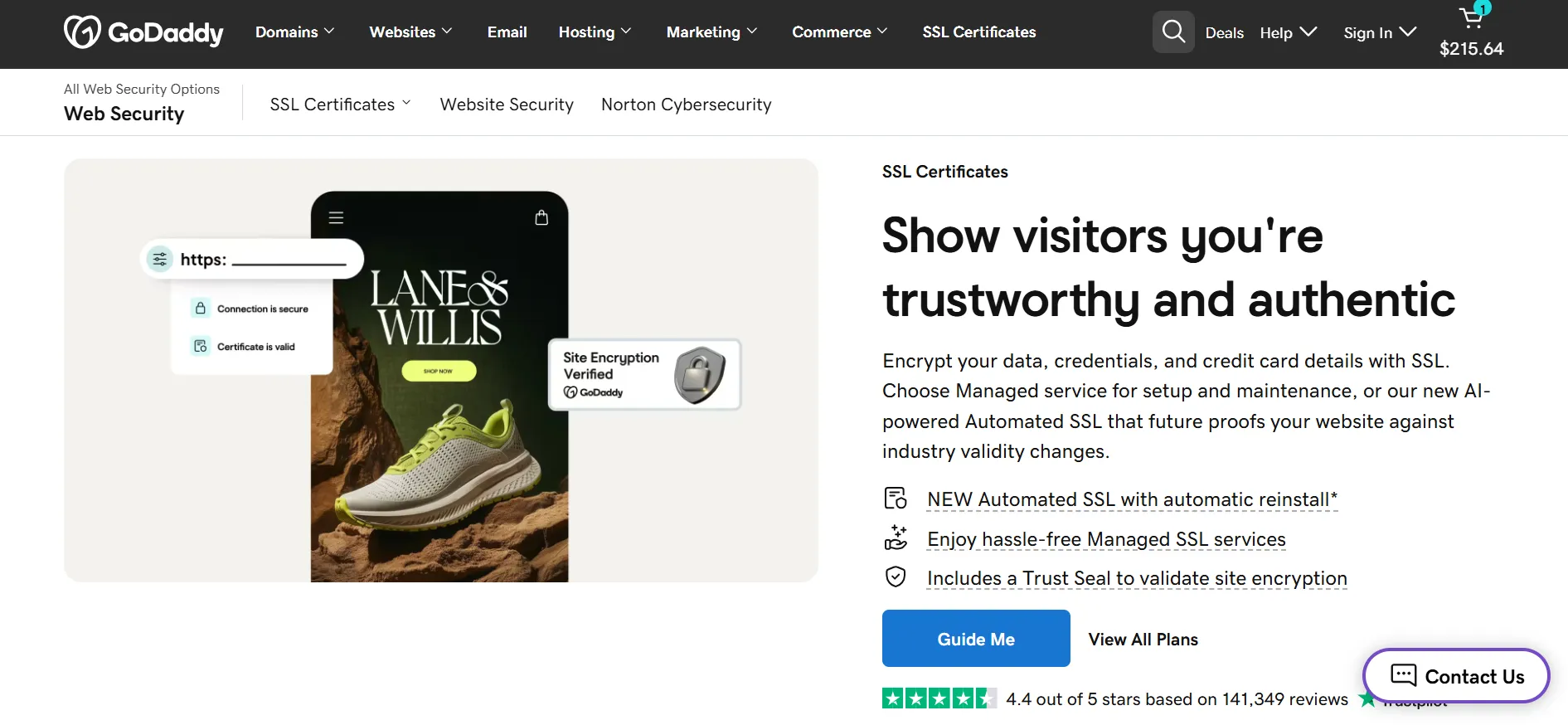
Here is the critical fact that frames this entire GoDaddy SSL review. A certificate’s job is encryption, and the encryption itself is identical whether you pay $0 or $500.
A free Let’s Encrypt certificate uses the same TLS protocols, the same key strengths, and the same browser trust as a commercial one. Browsers do not show visitors which certificate authority issued your cert. The padlock looks the same.
What paid certificates add is not encryption. It is validation depth, warranties, management convenience, and support. Whether those are worth $70 or more per year is the real question, and the answer depends entirely on your situation.
GoDaddy SSL Pricing in 2026: Full Breakdown
GoDaddy’s SSL catalog has three main flavors, and the pricing varies by term length. Here is the current picture.
Domain Validation Certificates
DV verifies you control the domain, nothing more. This is what 95 percent of websites need.
Self installed DV: around $69.99 per year, or roughly $5.99 per month on a three year term. You install and manage it yourself.
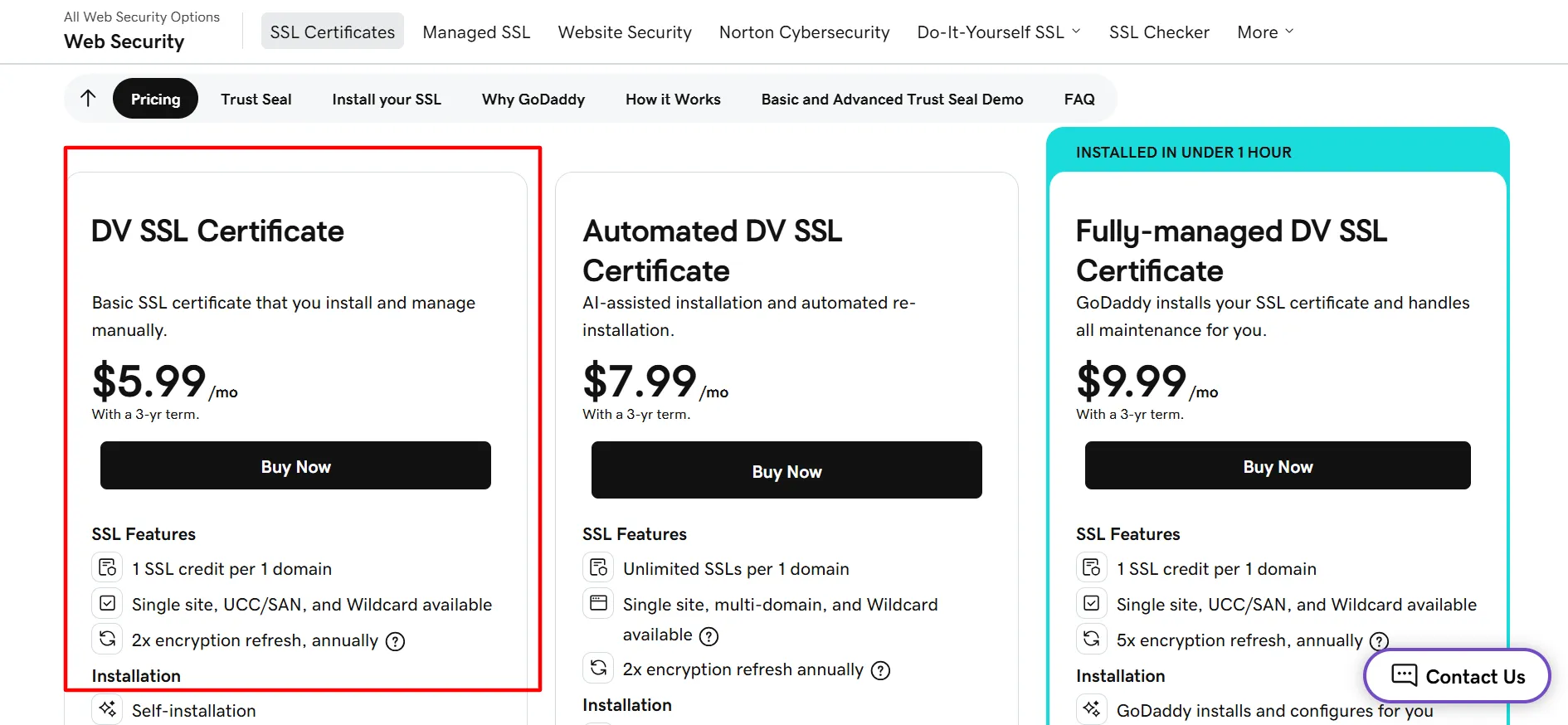
DV Automatic: around $8 per month equivalent, with AI assisted installation and automatic reinstallation.
Fully Managed DV: around $9.99 per month on multi year terms. GoDaddy installs, configures, reinstalls, and handles all troubleshooting and maintenance for you.
Wildcard Certificates
Wildcard DV: around $279.99 per year, or roughly $28.99 per month on a three year term. Secures your main domain plus every subdomain. Includes a $1,000,000 warranty, free unlimited reissues, 99 percent browser compatibility, and a 30 day refund policy.
Organization and Extended Validation
OV and EV certificates add business identity vetting, with EV historically displaying the company name in the browser. Pricing historically runs higher, into the low hundreds per year depending on type and term. Note that modern browsers have reduced the visual prominence of EV indicators, which has weakened the classic EV sales pitch.
What GoDaddy Hosting Customers Should Know
Here is the twist. Most GoDaddy hosting plans already include a free SSL certificate. The paid standalone certificates exist for externally hosted sites, specific validation needs, and users who want the managed service.
If you host with GoDaddy, check your plan before buying anything, because you may already be covered.
GoDaddy SSL vs Free Options: The Honest Comparison
GoDaddy SSL vs Let’s Encrypt
Let’s Encrypt is the free nonprofit certificate authority used by millions of sites, including some at NASA. The certificates are technically identical in encryption to GoDaddy’s. What differs:
Cost: free forever versus around $70 per year.
Lifetime: 90 days with free automated renewal versus one year.
Validation: domain validation only versus DV, OV, and EV options.
Warranty: none versus up to $1,000,000 on paid certificates.
Support: community forums versus 24/7 commercial support.
Management: full automation through the ACME protocol versus manual or paid managed service.
What the Let’s Encrypt comparisons leave out: GoDaddy has historically disabled automatic free SSL tools on its own cPanel hosting, pushing customers toward paid certificates, a practice the community has criticized for years.
If you host anywhere else, free certificates are typically one click. On GoDaddy hosting, manual workarounds every 90 days are sometimes the free path.
GoDaddy SSL vs Cloudflare
Cloudflare offers free universal SSL to anyone using its CDN, which also accelerates your site. For most small sites this is the best free option, full stop.
The catch is architectural: Cloudflare sits in front of your hosting, which is an extra dependency some prefer to avoid.
GoDaddy SSL vs Other Commercial CAs
DigiCert and Sectigo sell comparable certificates at enterprise prices. What their marketing leaves out: for a standard DV certificate, a $300 DigiCert cert and a $9 Namecheap cert encrypt identically.
You are paying for brand, warranty ceilings, and enterprise management tooling. Resellers like The SSL Store and Namecheap sell the same certificates at steep discounts.
A GoDaddy wildcard at $279.99 per year, for example, compares against PositiveSSL wildcard at $128 and RapidSSL wildcard at $130 for materially similar coverage.
GoDaddy SSL Features Explained in Detail
Explore every feature and capability included with GoDaddy SSL certificates in this detailed GoDaddy SSL certificate review covering security, validation levels, warranty, and browser compatibility.
1. Managed Installation
The strongest real argument for GoDaddy’s paid certificates. A fully managed plan means GoDaddy handles installation, renewal, reinstallation, and troubleshooting.
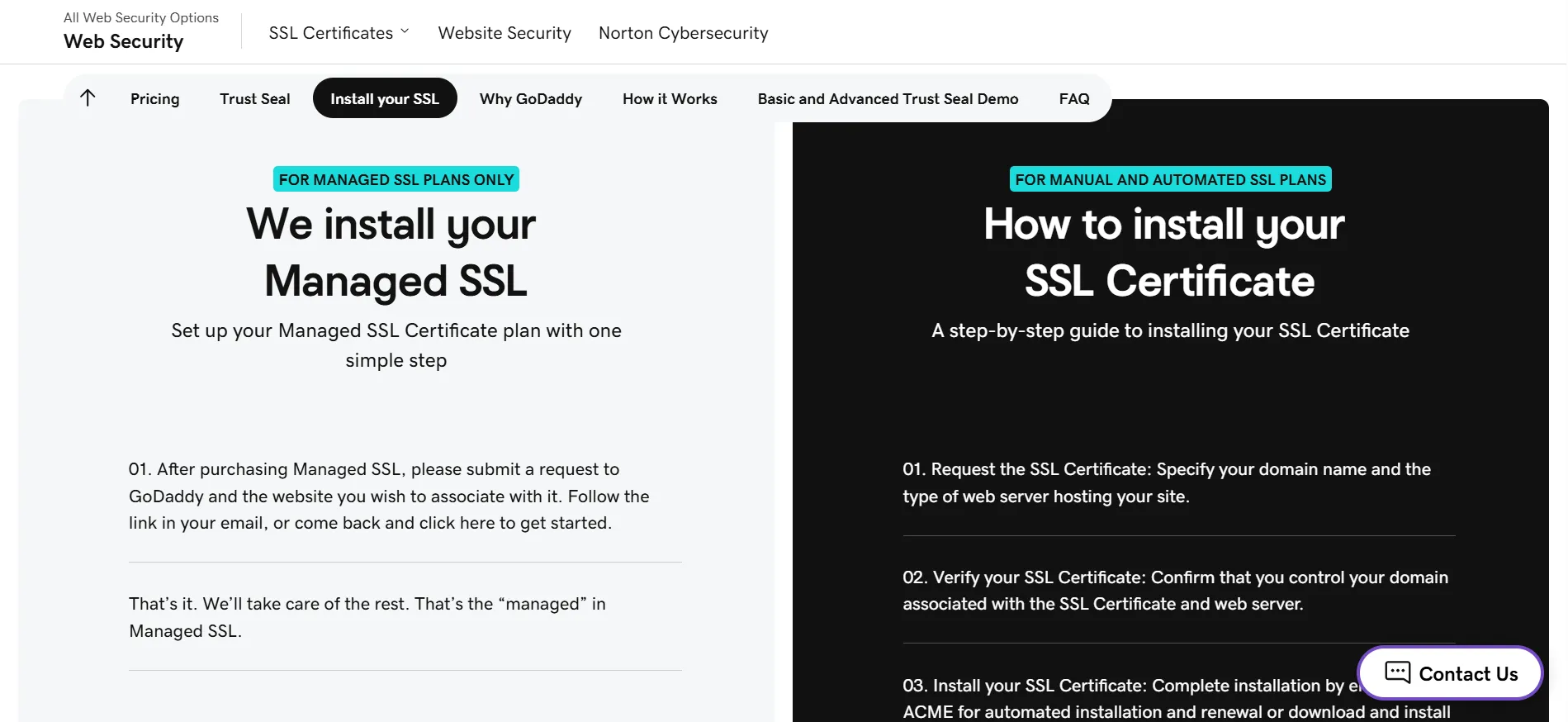
For a non technical small business owner with an externally hosted site and nobody on call, paying $120 a year to never think about certificates is rational.
2. Warranty Protection
Commercial certificates carry financial warranties, up to $1,000,000 on GoDaddy’s wildcard, protecting against losses from certificate mis issuance.
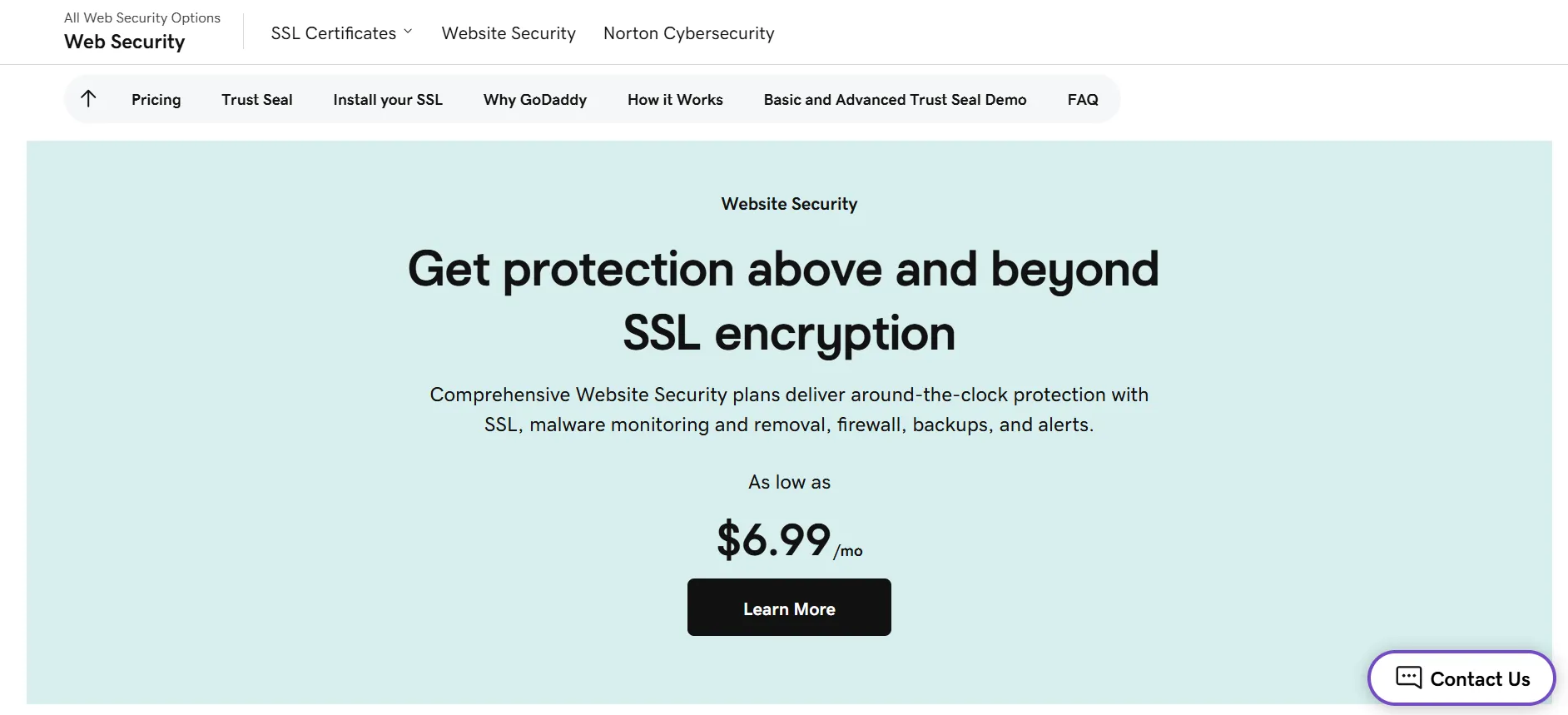
It is rarely claimed, but for ecommerce stores handling real payment volume, it is a genuine differentiator free certificates cannot match.
3. SSL Change Monitoring
The managed and automatic tiers alert you if anyone changes your certificate, a nice security touch that catches unauthorized modifications.
4. Trust Seals
GoDaddy site seals let you display verification on your pages. Testing has long shown mixed impact on conversion, but some ecommerce operators swear by them.
5. 24/7 Support
Real humans around the clock. Free certificate problems are solved in forums. Paid certificate problems are solved on the phone.
6. Validation Options
DV, OV, and EV coverage means businesses needing organizational vetting for compliance or procurement can get it, which free authorities do not offer.
Pros and Cons: GoDaddy SSL Certificate Review
Pros
- Managed options genuinely remove all certificate management burden.
- Warranty coverage up to $1,000,000 on select certificates.
- DV, OV, and EV validation types for different compliance needs.
- 24/7 human support.
- Trusted brand name procurement teams recognize.
Cons
- Around $70 per year for something available free elsewhere.
- Renewals can jump, especially on multi year plans, per user reviews.
Who Should Buy a GoDaddy SSL Certificate in 2026?
Buy it if:
You are non technical, your site is hosted externally, and you want certificate management fully off your plate.
You run an ecommerce store and value the warranty protection.
Your organization requires OV or EV validation for compliance or procurement.
You want one vendor for domain, hosting, email, and SSL with a single support line.
Do not buy it if:
You use any modern host or CDN. Free SSL is almost certainly already included.
You are comfortable with basic technical setup. Let’s Encrypt plus automation tools handles everything.
Budget matters. Namecheap and resellers sell equivalent certificates for under $10 per year.
You are on GoDaddy hosting. Check your plan, because free SSL is likely already there.
SSL Certificates Explained in Plain English
Since many readers of a GoDaddy SSL review are first time site owners, here is the mechanic without the jargon. When a visitor opens your site, their browser and your server perform a handshake.
The certificate is the server’s ID card, proving the server really belongs to your domain. Once trust is established, all traffic between them is encrypted so nobody in between can read it.
That ID card is issued by a certificate authority, which is GoDaddy, Let’s Encrypt, DigiCert, or one of a few dozen organizations whose root certificates are pre installed in every browser. Because all of these authorities follow the same standards, browsers treat their certificates identically.
This is why the price differences in this market are about service layers, not about the strength of the lock on your door.
DV vs OV vs EV: What the Validation Levels Actually Mean
Domain Validation, or DV, proves you control the domain. Issuance takes minutes. This covers blogs, portfolios, small business sites, and most ecommerce stores.
Organization Validation, or OV, proves your company is a real registered entity. The certificate contains your organization name, visible to anyone who clicks the padlock and inspects it. Issuance takes one to three days of vetting.
Extended Validation, or EV, adds deeper vetting and historically displayed your company name directly in the browser address bar. That visual treatment has been removed or minimized in modern browsers, which is why the EV premium has become hard to justify for most buyers.
Procurement departments at large enterprises still request OV and EV certificates, and that compliance driven demand is largely what keeps them alive.
GoDaddy offers all three levels. For a typical small site, DV is the right answer, and for a typical small site, free DV is the right price.
The Five Year Cost Reality
Certificates are an annual recurring cost, so the honest comparison is multi year. A single domain DV from GoDaddy at roughly $70 per year costs about $350 over five years.
A free Let’s Encrypt certificate costs $0 over five years with automated renewals. A Namecheap equivalent at under $10 per year costs about $44. A GoDaddy wildcard at $279.99 per year costs about $1,400 over five years, while reseller wildcards at $128 to $130 per year cost roughly $640 to $650.
Over any meaningful horizon, the price gaps dwarf the sticker differences, which is exactly why resellers and free authorities have eaten so much of this market.
What Happens When You Actually Buy One
The purchase flow at GoDaddy is straightforward. You pick a certificate type and term, complete checkout past the customary add on offers like website security bundles, submit a certificate signing request or let the system generate one, complete domain validation through email, DNS, or file upload, and receive the certificate for installation.
The self installed tier ends there, and you handle renewals and reinstallations yourself. The managed tier hands all of that to GoDaddy, including the 90 day or annual renewal cycles and any troubleshooting when something breaks.
First time buyers consistently underestimate how easy the self installed path is on modern hosts and how valuable the managed path is on legacy or externally hosted setups, so match the tier to your actual comfort level rather than defaulting to managed out of fear.
GoDaddy SSL Alternatives Summary
Here is the short decision path. Use your host’s free SSL, which almost every modern host includes automatically. Use Cloudflare’s free universal SSL if you want a CDN alongside.
Use Let’s Encrypt with a tool like Certbot if you control your own server. Use Namecheap or The SSL Store if you want a paid certificate with warranty at the lowest price. Use DigiCert if enterprise procurement demands the brand.
Use GoDaddy’s managed SSL only if you are non technical, externally hosted, and willing to pay for the convenience of never thinking about it. Every path ends at the same padlock. Only the price and the workflow differ.
A Note on the GoDaddy Free SSL Controversy
One topic every honest GoDaddy SSL review should mention: for years, users and security communities have criticized GoDaddy for disabling easy free SSL integrations on its own cPanel hosting while selling paid certificates, effectively creating a problem it then sells the solution to.
Community threads describe manual 90 day Let’s Encrypt renewals on GoDaddy hosting as unnecessarily painful compared to the one click automation available at almost every competitor.
Whether you view that as reasonable product segmentation or aggressive monetization, the practical effect is the same. If free automatic SSL matters to you, the hosting provider you choose matters more than the certificate authority you buy from.
Common Mistakes Buyers Make
A few errors show up repeatedly in support forums. First, buying a certificate you already have. Always audit your hosting plan and CDN before purchasing, because duplicate coverage is pure waste. Second, buying a wildcard when two single certificates would cost less.
If you have one domain and one subdomain, two DV certificates are cheaper than one wildcard. Third, choosing EV expecting a visible browser badge that modern browsers no longer display prominently.
Fourth, ignoring the renewal price and focusing only on the first term, a habit GoDaddy’s pricing structure unfortunately encourages. Fifth, assuming a paid certificate improves Google rankings.
It does not. Google treats all valid HTTPS certificates identically as a lightweight ranking signal. Paying more buys zero SEO advantage.
The Bottom Line on GoDaddy SSL for Ecommerce
Store owners often ask whether checkout security demands a paid certificate. The practical answer is no. The padlock, the encryption, and the browser trust are identical across free and paid DV certificates. Payment processors care that HTTPS exists, not who issued it.
Where paid certificates earn their keep for stores is the warranty layer, which protects against the rare event of a certificate authority’s mis issuance causing financial loss, and the managed service, which prevents the far more common disaster of an expired certificate taking checkout offline on a holiday weekend.
If your store does meaningful volume and you have no technical staff, paying for managed coverage is rational insurance. If you have any technical capability at all, automation achieves the same outcome for free.
FAQs: GoDaddy SSL Certificate Review
Yes. Browsers flag HTTP sites as not secure, which costs you visitors and trust regardless of site size. The good news is that a free certificate handles this perfectly.
HTTPS itself adds negligible overhead, and the HTTP/2 and HTTP/3 protocols that improve speed actually require HTTPS. In practice, moving to HTTPS plus a CDN usually makes sites faster.
Yes, through certificate files copied to each server or reissued copies, which GoDaddy allows freely on supported certificates.
Browsers display a scary security warning that blocks most visitors. This is the single strongest argument for managed or automated certificates over manual ones, because expiration outages are self inflicted and entirely preventable.
Quick Links:
Is GoDaddy SSL Worth It? My Final Verdict
The honest verdict in this GoDaddy SSL review is that the product is fine and the default answer for most readers is no. The certificates work, the managed service is genuinely convenient, and the warranty is real. But the encryption is identical to what you get free, and the pricing sits well above equivalent certificates from resellers.
The one scenario where GoDaddy SSL earns its price is the non technical owner of an externally hosted site who values never touching certificate management. For that person, $9.99 a month for fully managed peace of mind is reasonable.
For everyone else, the answer is free SSL from your host, Cloudflare, or Let’s Encrypt, and if you specifically need a paid certificate with warranty, buy from a reseller at a third of the price.
My recommendation: audit what you already have first. Check your hosting plan, check Cloudflare, and only pay for a certificate if you have a specific validation or management requirement that free options genuinely cannot meet.
Rating: 3.4 out of 5. The managed service and warranty are real value for a narrow audience. The pricing against free and reseller alternatives costs it heavily.