GoDaddy sells more domains than anyone on earth, and its VPS hosting quietly powers a huge slice of the small business web. The pitch is familiar. Big brand, one account for everything, managed convenience, and an entry price under $9 per month.

GoDaddy VPS hosting offers managed and unmanaged virtual private servers with flexible configurations (1 to 32 vCPU cores, 2GB to 128GB RAM), Linux or Windows operating systems, 99.9% uptime, 24/7 support, and DDoS protection. Trusted by 20+ million GoDaddy customers globally.
Pros
- Flexible configurations customize vCPU cores (1 to 32), RAM (2GB to 128GB), and storage (40GB to 1.5TB) to match your needs.
- Choice of OS select Linux (AlmaLinux, Debian, Ubuntu) or Windows Server with optional cPanel, WHM, or Plesk.
- 99.9% uptime guarantee with 24/7 network monitoring, DDoS protection, and automated daily backups included.
- Full root access complete control over server configuration, system files, and SSH access for developers and admins.
Cons
- Requires technical knowledge unmanaged plans need Linux command line and server administration experience.
- Manual patching required you handle OS updates and security patches on unmanaged plans.
But anyone who has read a GoDaddy VPS review before knows the pattern. That $8.99 price demands a three year upfront commitment, and the renewal math is where the deal goes to die.
GoDaddy’s own customers have been leaving for years, with migration data showing roughly ten companies moving to competitors like Hostinger for every one coming the other way.
So is GoDaddy VPS worth it in 2026? I dug into the full pricing including renewals, the real feature set, and how it compares against Hostinger, DigitalOcean, Namecheap, InterServer, and BearHost. This GoDaddy VPS review gives you the unfiltered answer.
GoDaddy VPS at a Glance: Quick GoDaddy VPS Review Overview
A concise snapshot of GoDaddy VPS hosting features, pricing structure, and platform strengths for fast understanding in this comprehensive GoDaddy VPS review.
Item | Details |
What it is | Virtual private server hosting from the world’s largest registrar |
Parent company | GoDaddy, founded 1997, publicly traded |
Entry price | $8.99 per month (36 month term) |
Entry renewal | $14.99 per month |
Top standard tier | 4 vCPU, 16 GB at $44.99 per month intro |
Storage | NVMe SSD on all plans |
Operating systems | Linux and Windows |
Control panel | cPanel or Plesk, paid add ons |
Data centers | US, Netherlands, Singapore |
Root access | Full |
Guarantee | 30 day money back |
Best for | Users who want one vendor for everything |
What Is GoDaddy VPS and Who Is It For?
A VPS, or virtual private server, gives you dedicated slices of a physical server: guaranteed CPU, RAM, and storage that nobody else can touch. Compared to shared hosting, that means predictable performance under load, root access for custom software, and room to grow without migrating.
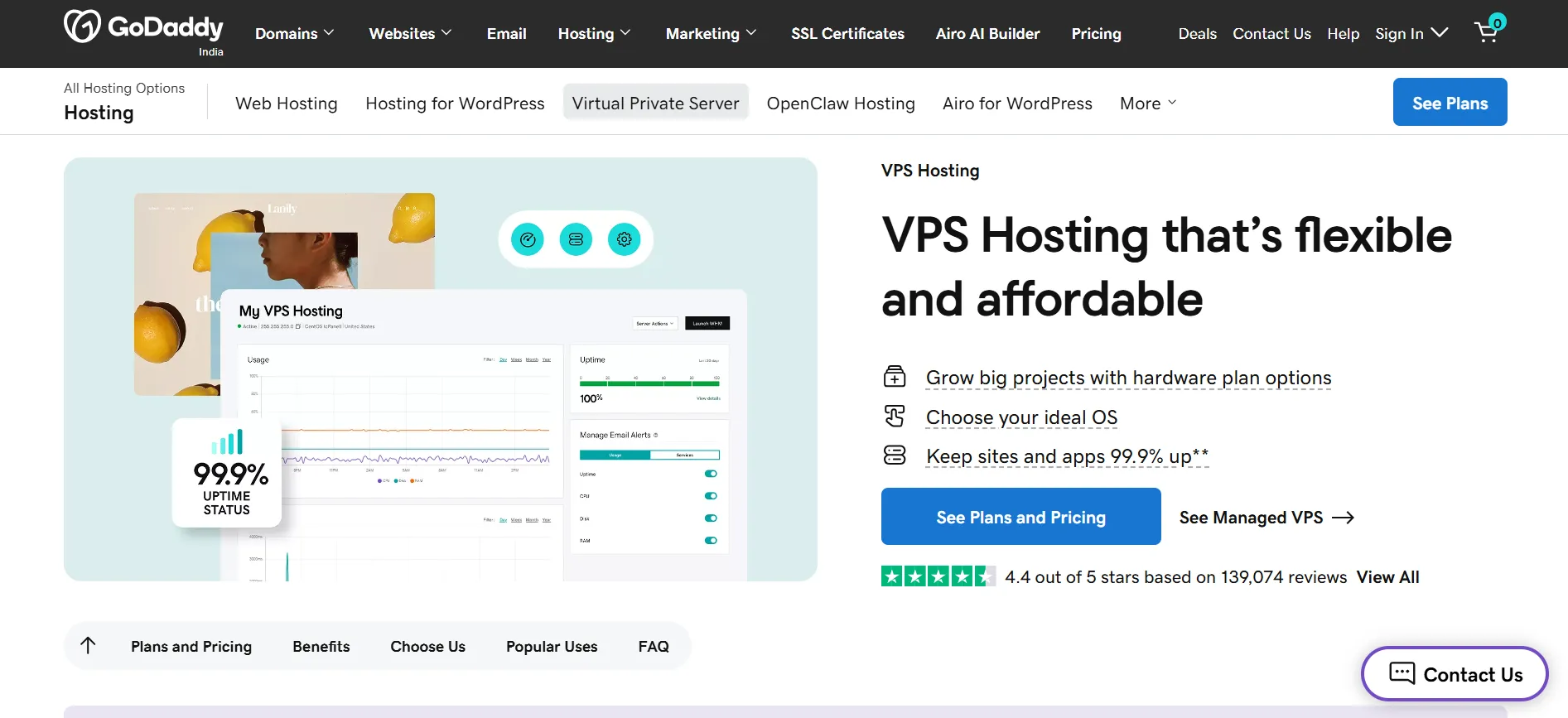
GoDaddy’s VPS lineup covers standard performance tiers for typical business sites and high performance tiers for demanding workloads.
Every plan includes KVM virtualization, NVMe SSD storage, full root access, snapshot backups, DDoS protection, and a choice of Linux or Windows. Unmetered bandwidth applies across the range.
GoDaddy VPS is best for small business owners already deep in the GoDaddy ecosystem who want server power without shopping elsewhere.
It is a poor fit for cost optimizers, because the renewal prices are among the steepest in the industry, and for developers who want transparent hourly billing, because everything runs on long contracts.
The Big News: The Renewal Reality Nobody Advertises
Here is the single most important fact in this GoDaddy VPS review. The advertised prices require 36 months paid upfront, and renewals roughly double.
The entry 1 vCPU, 2 GB plan costs $8.99 per month on a three year term, meaning about $323.64 due at signup. It renews at $14.99 per month, pushing the same server to roughly $539.64 over the following three years. The 2 vCPU, 4 GB plan runs $17.99 intro and $29.99 at renewal.
The 4 vCPU, 8 GB plan runs $34.99 intro and $59.99 at renewal. The top standard tier, 4 vCPU with 16 GB, runs $44.99 intro and $74.99 at renewal.
Independent five year cost analysis puts this in perspective. Five years of the entry GoDaddy VPS totals around $683. The same period at Hostinger runs roughly $587, at Namecheap around $281, and some budget competitors come in lower still. GoDaddy finishes last or second to last in nearly every long term comparison.
There is also a hidden fee pattern worth knowing. On some plan generations, the free SSL included at signup does not renew free, adding over $130 per year at renewal. Control panels are extra too: cPanel or Plesk licenses are paid add ons rather than bundled services, unlike most managed VPS competitors.
Here is my honest take. The hardware and infrastructure are solid. The renewal economics are not, and in 2026 there is no technical reason to pay them when competitors deliver equal or better specs at half the long term cost.
GoDaddy VPS by the Numbers: Stats That Matter in 2026
Entry pricing: $8.99 per month requiring 36 months upfront, renewing at $14.99.
Standard tier range: four plans from 1 vCPU and 2 GB up to 4 vCPU and 16 GB, all on NVMe SSD.
Five year entry cost: approximately $683 at GoDaddy versus roughly $587 at Hostinger and around $281 at Namecheap.
Data centers: US, Netherlands, and Singapore locations.
Uptime guarantee: 99.9 percent, consistent with the industry standard.
Snapshot backups: included, though backup storage beyond roughly 1 GB costs extra.
Operating system flexibility: Linux and Windows, with Plesk available on Windows, a genuine differentiator many budget hosts skip.
Migration trend: third party data shows roughly ten businesses moving from GoDaddy to Hostinger for every one moving in the opposite direction over a five year window.
Free SSL: included on some plans for the first term only, with renewal charges applying afterward on affected tiers.
Support: 24/7 phone and live chat, one of the few hosts with real phone access, and a PIN based verification system agents require before helping.
Free tier adjacent: Web Hosting Plus, from around $21.99 per month, gives VPS level resources with a familiar cPanel interface for users who want power without server administration.
GoDaddy VPS Pricing in 2026: Full Breakdown
A complete overview of GoDaddy VPS pricing tiers, monthly and annual costs, server specifications, and plan features reflecting current rates in this GoDaddy VPS review.
Standard Performance Plans
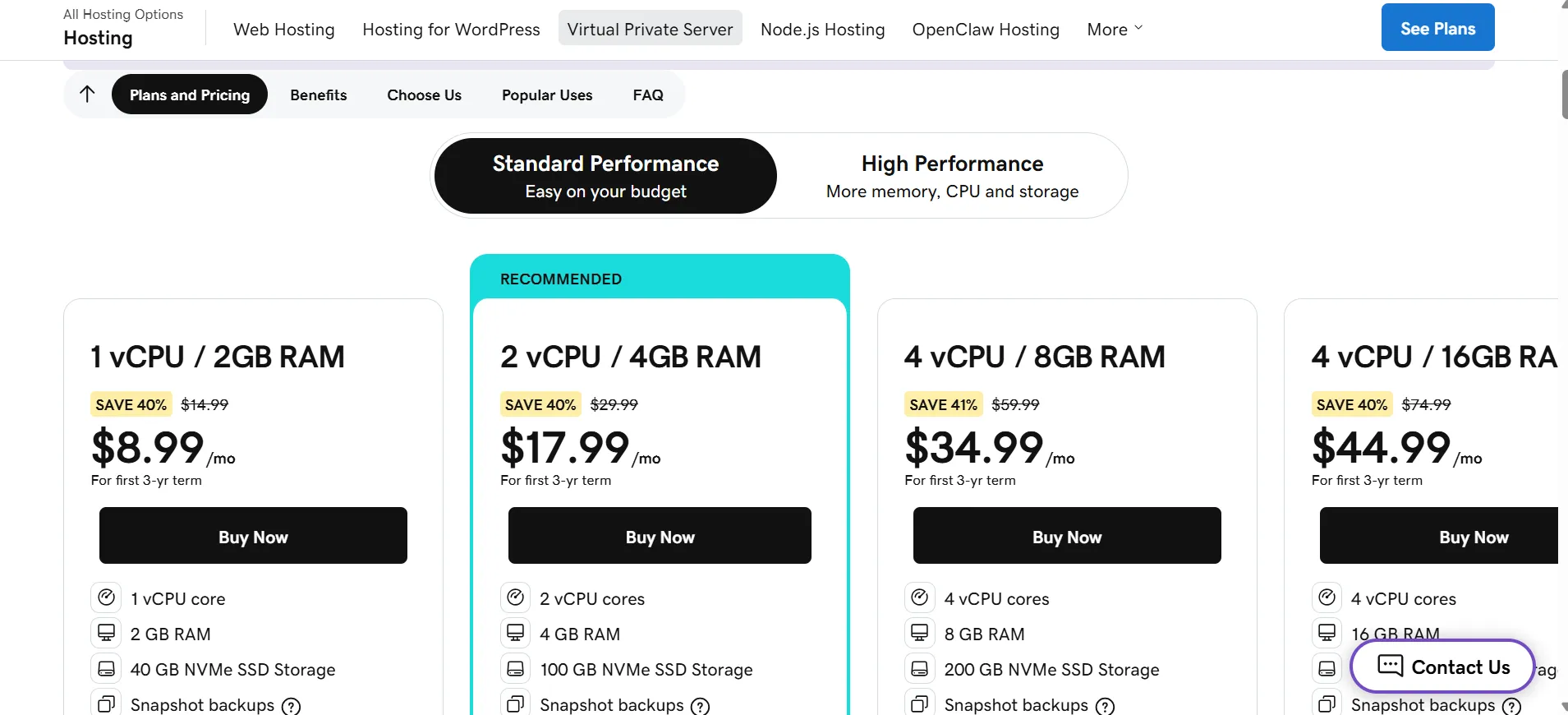
1 vCPU, 2 GB RAM, 40 GB NVMe: $8.99 per month on a 36 month term, renewing at $14.99. Linux only. Best for a single site that needs consistent power.
2 vCPU, 4 GB RAM, 100 GB NVMe: $17.99 per month on 36 months, renewing at $29.99. Adds a Windows option. The sweet spot for growing businesses.
4 vCPU, 8 GB RAM, 200 GB NVMe: $34.99 per month intro, $59.99 renewal. Suitable for busy ecommerce stores and small agencies.
4 vCPU, 16 GB RAM, 200 GB NVMe: $44.99 per month intro, $74.99 renewal. Maximum standard tier before high performance plans.
High Performance Plans
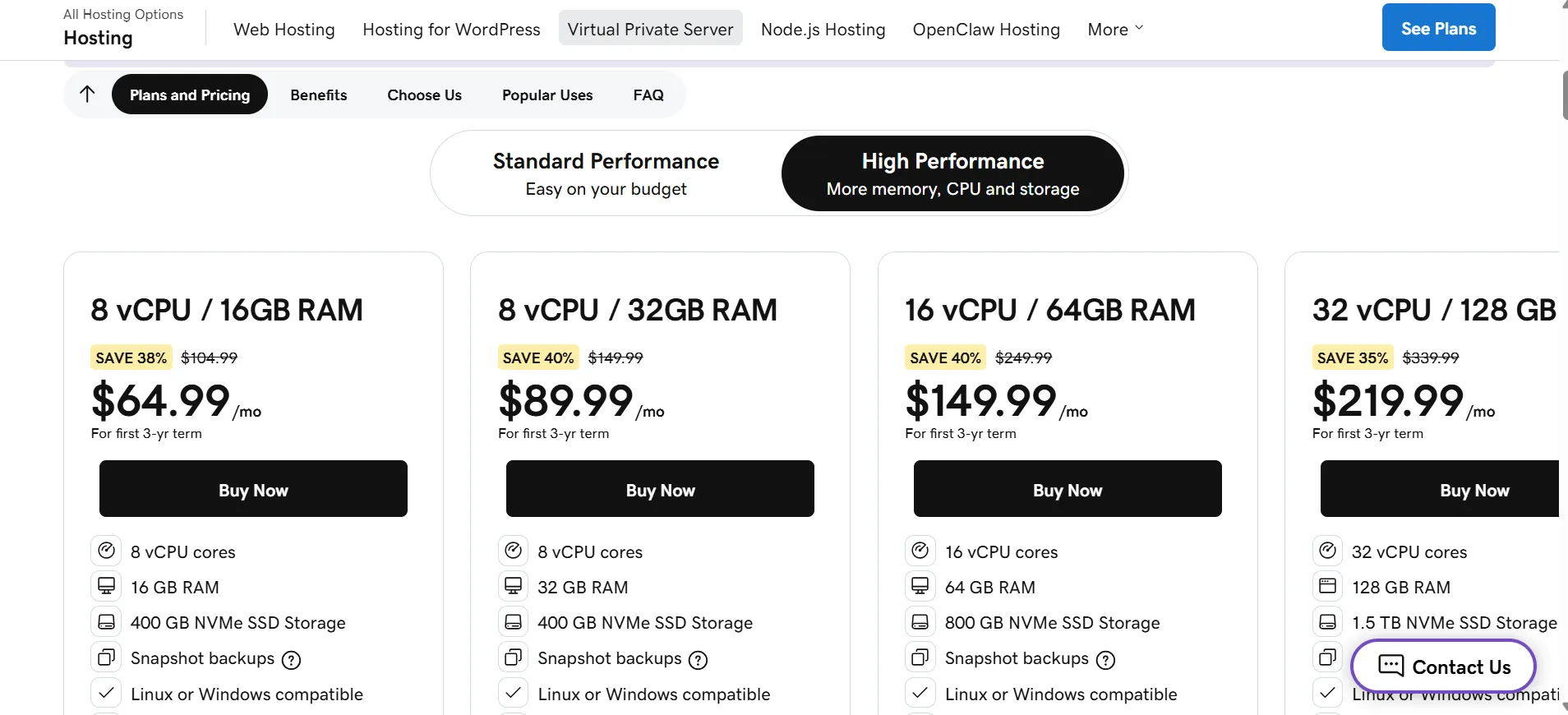
Above the standard range sits a high performance lineup with faster processors and higher throughput for demanding workloads, priced accordingly and available in the same four step structure.
Add Ons and Hidden Costs
Control panels: cPanel or Plesk licenses are separate purchases, a significant annual cost competitors often bundle.
SSL at renewal: on affected plans, the certificate that was free at signup renews at a paid rate, historically over $130 per year.
Backup storage: snapshot space beyond the small included allowance costs extra.
Web Hosting Plus: from $21.99 per month, a middle option combining VPS resources with managed cPanel convenience for users intimidated by raw servers.
My Read on the Pricing
The intro prices are competitive. The renewal prices are not, and because the good rates demand three year commitments, you are effectively pre paying for a discount that evaporates the moment the term ends.
If you choose GoDaddy VPS anyway, mark your calendar for renewal negotiation and be prepared to call, because phone negotiation is where GoDaddy’s retention team lives.
GoDaddy VPS Features Explained in Detail
Explore every core feature and tool included with GoDaddy VPS hosting in this detailed GoDaddy VPS review covering server management, security, performance, and support options.
1. NVMe Storage Across the Range
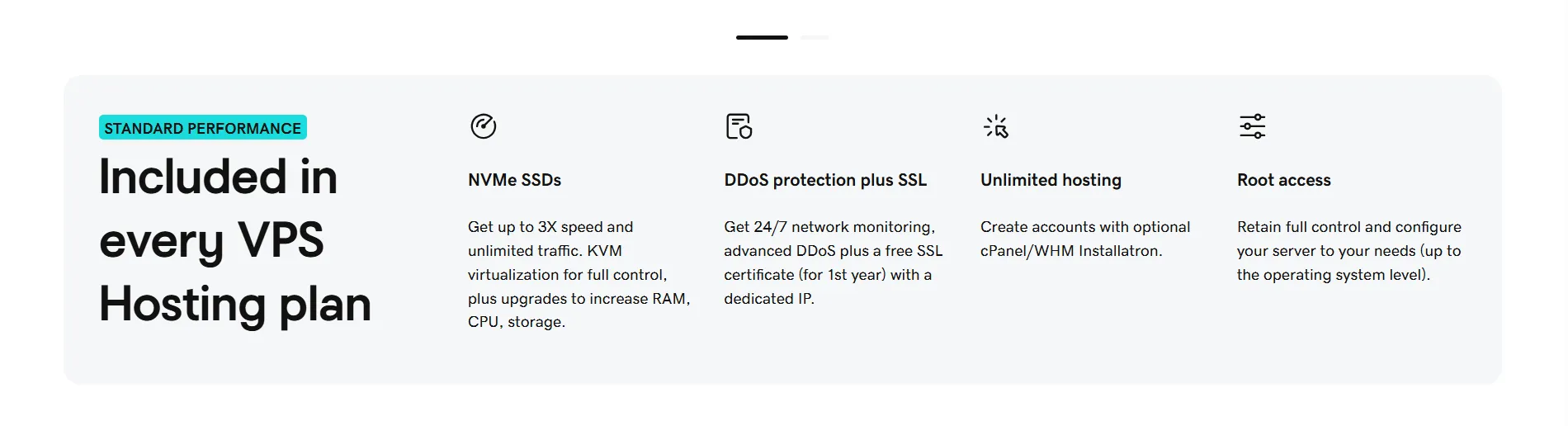
Every plan runs NVMe SSDs, which are meaningfully faster than the SATA SSDs some budget hosts still ship. Real world load times benefit noticeably, especially for database heavy sites.
2. Linux and Windows Choice
Most budget VPS providers are Linux only. GoDaddy offers Windows Server with Plesk as a first class option, which matters for businesses running ASP.NET applications or Microsoft SQL workloads. This is a genuine differentiator in the budget tier.
3. Full Root Access
Complete server control for installing custom software, configuring services, and tuning performance. Developers get what they need without restrictions.
4. Snapshot Backups
One click snapshots let you capture server state before risky changes and roll back if something breaks. The included storage allowance is small, so heavy users should budget for expansion.
5. DDoS Protection and Network Security
Infrastructure level mitigation is included, covering the standard attack volume typical for small business sites.
6. Unmetered Bandwidth
No metering anxiety on normal traffic. Extreme sustained throughput can still trigger acceptable use review, but typical business sites will never approach it.
7. The GoDaddy Ecosystem
One account covers domains, email, hosting, SSL, and a website builder. For business owners who value consolidation and a single support phone number, this convenience is real, and it is the strongest argument in this entire review.
8. Phone Support
24/7 phone access with PIN verification. In an industry racing to chatbots, a human on the phone has genuine value, even if experiences vary.
9. What GoDaddy VPS Does Not Do Well
No hourly billing, no price transparency at renewal, no bundled control panel, US centric plus two international data centers, and a backup allowance that feels stingy. Support quality is inconsistent according to long term user reports, though recent testing found agents quick and polite.
Pros and Cons: GoDaddy VPS Review
Pros
- Competitive entry pricing with NVMe storage included from the cheapest tier.
- Both Linux and Windows with Plesk, rare at this price.
- Full root access with KVM virtualization.
- Snapshot backups and DDoS protection included.
- Unmetered bandwidth on all plans.
Cons
- Renewals roughly double, among the steepest in the industry.
- Headline prices require 36 month upfront commitments.
GoDaddy VPS vs Competitors: Complete 2026 GoDaddy VPS Review Comparison
See how GoDaddy VPS stacks up against Bluehost VPS, SiteGround, Kinsta, and other VPS providers in this GoDaddy VPS review, comparing features, pricing, and overall value.
GoDaddy VPS vs Hostinger
Hostinger’s KVM VPS starts under $6 per month with a more modern management layer and AI assisted server tasks.
What Hostinger comparisons leave out: entry tiers share CPU cycles and can feel oversold, and renewals jump there too, though from a lower base.
Migration data shows ten to one movement toward Hostinger. For most buyers, Hostinger wins on price to performance.
GoDaddy VPS vs DigitalOcean
DigitalOcean offers developer grade droplets from around $4 to $6 per month with hourly billing, a mature API, and a massive tutorial library.
What DigitalOcean comparisons leave out: you are the sysadmin. There is no phone support and no hand holding. GoDaddy VPS is for owners, DigitalOcean is for developers.
GoDaddy VPS vs Namecheap
Namecheap’s VPS starts around $3.88 per month with transparent renewals and a five year cost roughly 40 percent below GoDaddy’s.
What Namecheap comparisons miss: a more basic feature set, fewer data centers, and weaker support depth. For pure cost, Namecheap wins decisively.
GoDaddy VPS vs InterServer
InterServer’s slice model starts around $6 per month per slice with monthly billing, price locks, and managed support at eight slices.
What InterServer comparisons leave out: US only data centers and a dated interface. For flexibility and honest billing, InterServer wins.
Quick Comparison Table: GoDaddy VPS Review vs Competitors
Compare GoDaddy VPS against Bluehost, SiteGround, DigitalOcean, and other VPS providers in this GoDaddy VPS review table showing pricing, features, and key differences at a glance.
Factor | GoDaddy | Hostinger | DigitalOcean | Namecheap | InterServer |
Entry intro | $8.99/mo | ~$5.99/mo | ~$4 to 6/mo | ~$3.88/mo | ~$6/slice |
Entry renewal | $14.99/mo | ~$10.99/mo | Same hourly | ~$9.88/mo | Locked |
Commitment | 36 months | 12 to 48 | None | 1 to 12 | Monthly |
Windows option | Yes, Plesk | No | No | No | Yes |
Control panel | Paid add on | hPanel | None | cPanel paid | DirectAdmin |
Phone support | Yes | No | No | No | Yes |
Best for | Ecosystem loyalists | Budget performance | Developers | Cost minimizers | Honest billing |
Who Should Use GoDaddy VPS in 2026?
GoDaddy VPS is worth it if:
You run Windows workloads needing Plesk at a budget price.
You want one vendor, one bill, and one phone number for everything online.
You are upgrading from GoDaddy shared hosting and value continuity over cost.
You will negotiate at renewal and refuse the standard rates.
GoDaddy VPS is probably not for you if:
Long term cost matters. Namecheap and InterServer undercut it massively.
You want hourly billing or short commitments.
You are a developer. DigitalOcean or Vultr serve you better.
You resent renewal games. The 100 percent price jump will annoy you every three years.
The Migration Math, Explained
One of the most useful things a GoDaddy VPS review can quantify is what staying costs versus leaving. Over a five year horizon, independent analysis puts the entry GoDaddy VPS at roughly $683. The equivalent at Hostinger runs about $587. At Namecheap, around $281.
At InterServer with its locked monthly pricing, the total lands near the low end as well. That means migrating a single entry level server from GoDaddy to a budget competitor saves somewhere between $100 and $400 over five years, per server, before counting add on differences like control panel licenses and SSL renewals.
For an agency running five client VPS instances, the same decision is worth $500 to $2,000. This is why the migration ratios look the way they do, and it is why GoDaddy’s phone support team is famously willing to negotiate when you call to cancel. Your leverage is real. Use it at every renewal.
GoDaddy VPS Alternatives Summary
Here is the short decision path by buyer type. Developers should start at DigitalOcean or Vultr for hourly billing and full control. Cost minimizers should look at Namecheap or InterServer, where five year totals run far lower.
Windows workload owners have fewer options, and GoDaddy or InterServer both serve them well, with Plesk available at both. Users who want managed convenience without server administration should consider GoDaddy’s Web Hosting Plus or a managed host like Cloudways sitting on top of a cloud provider.
And ecosystem loyalists who simply want everything under one GoDaddy login should still negotiate at renewal, because the retention discounts exist precisely for you.
The market has an answer for every budget and skill level. GoDaddy VPS answers one specific question: what if I want it all from one brand and will pay a premium for that convenience.
One Final Practical Warning
If you do sign up for GoDaddy VPS on a 36 month term, take two protective steps on day one. First, note your renewal date in at least two places, because GoDaddy’s renewal emails are easy to miss and the price change is dramatic.
Second, immediately after provisioning, test the snapshot backup restoration process on a trivial file, because discovering a broken backup workflow during a real emergency is a lesson nobody enjoys.
These two habits cost ten minutes and eliminate the two most common regrets in long term GoDaddy reviews: surprise renewal bills and untested restores.
Who Founded GoDaddy?
GoDaddy was founded in 1997 in Phoenix, Arizona by Bob Parsons, originally as Jomax Technologies, renamed GoDaddy in 1999. It went public in 2015 and now manages tens of millions of domains, making it by far the largest domain registrar in the world.
That scale is the real reason its hosting products stay competitive on entry pricing, and the same scale explains the renewal economics, because a customer base measured in the tens of millions can absorb churn that would sink smaller rivals.
Does GoDaddy VPS offer a money back guarantee?
Yes, new VPS plans carry a 30 day money back guarantee, giving you a risk free window to benchmark real workload performance before the long commitment locks in.
FAQs: GoDaddy VPS Review
Entry plans start at $8.99 per month on a 36 month term, renewing at $14.99. Standard tiers run up to $44.99 per month intro, $74.99 at renewal.
A middle tier from around $21.99 per month combining VPS level resources with managed cPanel convenience for users who want power without server administration.
No. cPanel and Plesk licenses are paid add ons on VPS plans, though Web Hosting Plus bundles a panel experience.
Yes. Windows Server options with Plesk are available from the 2 vCPU tier upward, a genuine differentiator among budget hosts.
99.9 percent, backed by a 30 day money back guarantee on new plans.
The standard VPS is self managed with full root access. Web Hosting Plus and the managed tiers handle administration for you.
US locations plus the Netherlands and Singapore.
For most buyers, Hostinger on price to performance. Choose GoDaddy if Windows workloads, phone support, or single vendor consolidation outweigh cost.
Quick Links:
Is GoDaddy VPS Worth It? My Final Verdict
GoDaddy VPS is a competent product wrapped in uncompetitive economics. The servers are solid, the Windows support is genuinely useful, the phone access is rare, and the ecosystem convenience is real.
None of that changes the core problem: you can get equal or better infrastructure elsewhere for 40 to 60 percent less over any multi year horizon, and the three year lock in means you feel that problem slowly, then all at once.
The migration data tells the market’s verdict. Ten companies leave for every one that arrives. That is not a branding problem. That is a pricing problem.
My recommendation: if you are already embedded in GoDaddy and want the easiest upgrade path, buy the 2 vCPU plan, set a renewal reminder for month 34, and negotiate hard or migrate when the term ends.
If you are starting fresh, start at Hostinger or InterServer instead and keep the hundreds of dollars you would have donated to renewal math.
Rating: 3.6 out of 5. Capable servers and real differentiators, dragged down by renewal economics that no informed buyer should accept without negotiation.