
Affiliate marketing is a formidable pillar of digital marketing, empowering individuals and businesses alike to generate substantial commissions by effectively promoting products and services.
As we navigate through 2025, the industry is not merely holding its ground; it is aggressively expanding, estimated to be worth an impressive $17 billion this year and projected to surge to $27.78 billion by 2027.
This growth trajectory underscores its critical role in e-commerce, driving a significant 16% of all online orders in the United States alone.
The widespread adoption of affiliate marketing is undeniable, with 81% of advertisers and 84% of publishers actively engaging in these programs, and a compelling 31% of web publishers relying on it as their primary source of income. Its effectiveness is further solidified by an average return of $12 for every $1 spent on advertising, proving its potent ability to boost sales and enhance brand awareness.
This in-depth article will meticulously explore the latest affiliate marketing statistics for 2025, delving into market size, revenue potential, usage patterns, and emerging trends.
We aim to equip readers with a comprehensive understanding of this dynamic industry, offering actionable insights on how to leverage affiliate marketing for their strategic benefit, drawing upon the newest data and real-world questions from platforms like Quora and Reddit.
Affiliate Marketing’s Ascendancy: Key Statistics for 2026
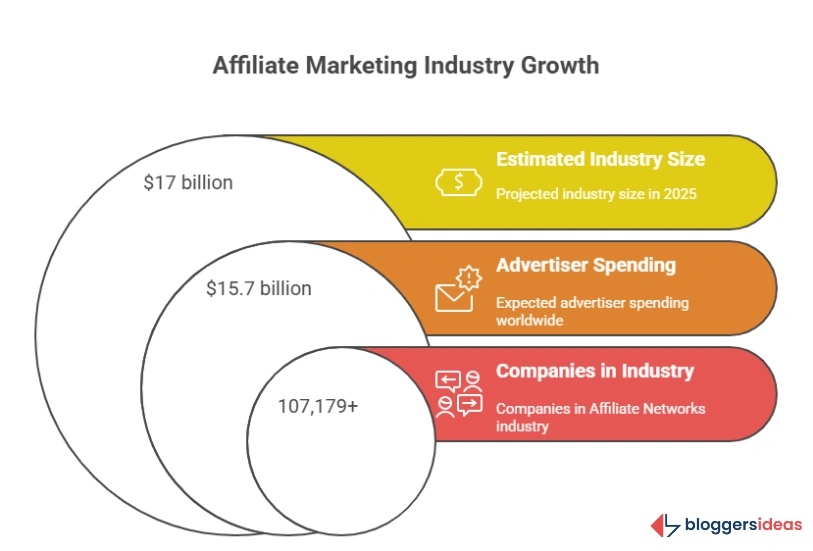
The sheer scale and impact of affiliate marketing in 2025 are reflected in several compelling statistics:
- The affiliate marketing industry is poised to reach an estimated $17 billion in 2025.
- Worldwide, affiliate marketing advertisers are expected to spend approximately $15.7 billion.
- More than 107,179 companies globally constitute the robust Affiliate Networks industry.
- In the United States, over 16% of all online orders originate through affiliate marketing channels.
- An impressive 81% of marketers actively utilize affiliate marketing to elevate brand recognition.
- Many of the world’s leading businesses attribute 5% to 30% of their online revenue to affiliate marketing.
- Over 84% of brands have an established affiliate program, demonstrating widespread industry acceptance.
- Blogging and review sites emerge as the leading channels for successful affiliate marketing endeavors.
- Amazon’s affiliate program maintains its position as the largest globally, highlighting its dominant market presence.
These top-tier statistics illuminate the pervasive influence and financial muscle of affiliate marketing within the digital economy.
Also read about: The Ultimate Guide to Affiliate Marketing Partnerships 2025
General Affiliate Marketing Trends and Insights
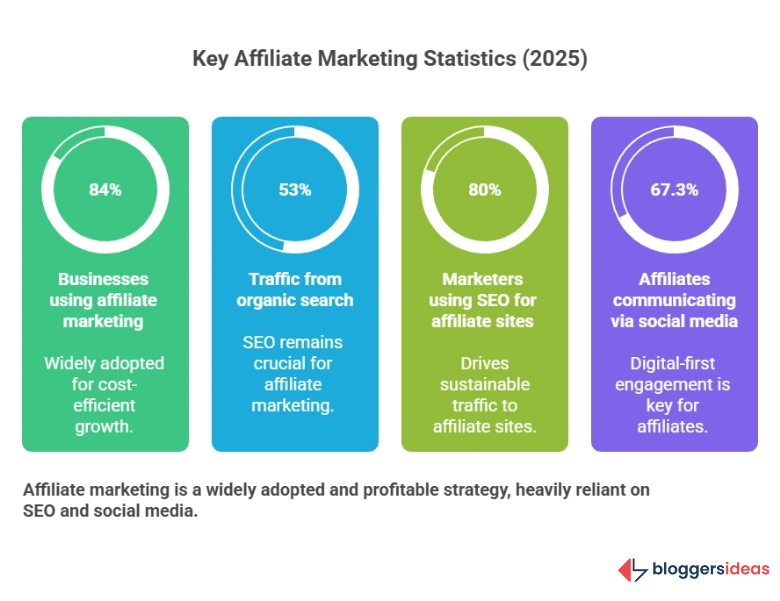
Affiliate marketing continues to thrive in 2025, evolving into one of the most effective digital revenue models. In the United States, affiliate publishers earn nearly 40% of their income from blogs and articles, proving content remains the backbone of affiliate success. Searches for “affiliate marketing” have surged over 300% since 2015, showing growing global interest.
Today, 84% of businesses use affiliate marketing to boost sales and cut ad costs, achieving an average ROI of $12 for every $1 spent. Organic search drives 53% of traffic, with 80% of marketers relying on SEO to attract visitors.
Additionally, 40% of digital marketers see affiliate marketing as a vital skill, and 40% of U.S. firms cite it as their main customer acquisition channel.
Key Affiliate Marketing Statistics (2025)
| Metric | Percentage / Value | Insight |
|---|---|---|
| Businesses using affiliate marketing | 84% | Widely adopted for cost-efficient growth |
| Average ROI | $12 per $1 spent | High profitability |
| Traffic from organic search | 53% | SEO remains crucial |
| Marketers using SEO for affiliate sites | 80% | Drives sustainable traffic |
| Affiliates communicating via social media | 67.3% | Digital-first engagement |
| Affiliate programs in apparel industry | 25% | Leading sector |
| Mobile traffic share | 50% | Optimize for mobile users |
| Affiliates promoting B2C products | 81.4% | Focus on consumer markets |
| Marketers using multiple programs | 94% | Diversification for stability |
| Shoppers visiting affiliate sites before purchase | 74% | Informed buying behavior |
Source: Statista
Affiliate marketing also plays a major role in customer retention (79%), while 65% of affiliates use blogs to attract audiences. Most operate across three or more networks, and for top brands, affiliates contribute 5%–25% of total online sales. This steady growth confirms affiliate marketing as a key pillar of modern digital strategy.
Also read about: Marketing Automation Statistics
Market Size and Revenue: A Booming Industry
The affiliate marketing industry’s financial trajectory is nothing short of impressive, demonstrating sustained and accelerated growth. In 2025, the market is projected to reach $17 billion, marking a significant increase from $15.7 billion in 2024 and $14.3 billion in 2023.
This upward trend is expected to continue vigorously, with the market size projected to reach $27.78 billion by 2027. Looking further ahead, at a robust CAGR of 15.44%, the affiliate marketing market size is expected to double, reaching an astounding $38.35 billion by 2030.
Here is a table illustrating the projected global affiliate marketing market size over the years:
| Year | Global Market Size (USD Billion) |
| 2030* | $38.35 billion |
| 2027* | $27.78 billion |
| 2025 | $17 billion |
| 2024 | $15.7 billion |
| 2023 | $14.3 billion |
These figures underscore the immense financial opportunities within the affiliate marketing ecosystem. Supporting this optimistic outlook, 86% of publishers anticipate their affiliate marketing revenue will either remain stable or increase in the future.
Furthermore, a substantial 73% of retailers report that their affiliate marketing initiatives successfully meet their income goals, validating the channel’s effectiveness for businesses.
For affiliates themselves, the earning potential is significant. Affiliate marketing generates at least $20,000 in yearly revenue for 35% of affiliates, indicating a healthy income stream for a considerable portion of practitioners.
At the higher end, 15% of affiliate marketers earn between $80,000 and $1 million annually, showcasing the potential for substantial wealth generation.
Here is a table breaking down the average income tiers for affiliate marketers:
| Income | Share of Affiliate Marketers |
| Up to $80,000 | 80% |
| $80,000 to $1 Million | 15% |
| Over $1 Million | 1% |
Source: eMarketer.
Affiliate Marketing Revenue and Earning Potential by Career Stage and Niche
The income potential in affiliate marketing varies significantly based on an individual’s experience level. Beginner marketers typically earn an average of $0 to $1,000 per month as they establish their presence and refine their strategies.
In contrast, super affiliates, representing the pinnacle of the profession, can earn upwards of $100,000 monthly, demonstrating the immense scalability of this business model.
The following table provides a detailed breakdown of affiliate income tiers, outlining what affiliates can realistically expect to earn at various stages of their career:
| Affiliate Marketer Career State | Affiliate Marketing Income Per Month |
| Beginner | $0 to $1,000 per month |
| Intermediate | $1,000 to $10,000 monthly |
| Advanced | $10,000 to $100,000 per month |
| Super Affiliate | over $100,000 monthly |
Beyond experience, the chosen niche profoundly impacts an affiliate marketer’s earnings. Education and Travel are the most profitable affiliate marketing niches, with impressive average monthly incomes.
Marketers in the education or e-learning industry earn an average of $15,551 per month, while those in the travel niche earn approximately $13,847 per month. Beauty and skincare, along with finance, are highly lucrative niches.
Here is a table displaying the average monthly income of affiliate marketers across various niches:
| Niche | Average Monthly Income |
| Education and eLearning | $15,551 |
| Travel | $13,847 |
| Beauty and Skincare | $12,475 |
| Finance | $9,296 |
| Technology | $7,418 |
| Digital Marketing | $7,217 |
| Health & Fitness | $7,194 |
| E-commerce | $5,967 |
| Home & Garden | $5,095 |
| Sports & Outdoors | $4,849 |
| Entertainment | $4,416 |
| Food & Nutrition | $3,015 |
| Fashion | $2,049 |
| Personal Development | $1,566 |
| Parenting & Family | $1,145 |
| Arts & Crafts | $1,041 |
| Pets & Animals | $920 |
| Sustainability & Environment | $555 |
These niche-specific insights highlight the importance of strategic niche selection for optimizing earning potential within affiliate marketing.
Also read about: Why Should You Join Affiliate Marketing Forums in 2025?
Affiliate Marketing Spending and Industry Structure
Global affiliate market spending is estimated to exceed $15.7 billion, reflecting substantial investments by advertisers in this channel.
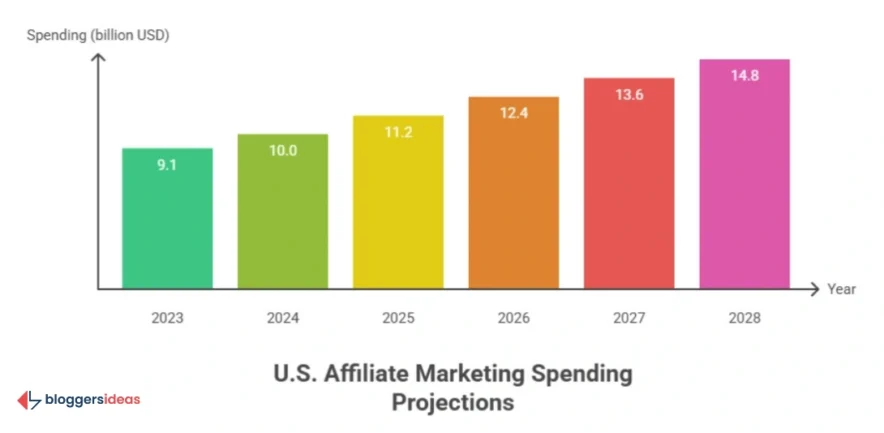
The United States stands as a dominant force in this spending, with its affiliate marketing industry projected to exceed $10 billion for the first time in 2024, up from $9.1 billion in 2023. This upward trend is expected to continue, reaching an impressive $14.8 billion by the end of 2028.
Here are the projected US affiliate marketing spending figures:
| Year | US Affiliate Marketing Spending |
| 2023 | $9.1 billion |
| 2024 | Expected to exceed $10 billion |
| 2025 | Projected to reach $11.2 billion |
| 2026 | Projected to reach $12.4 billion |
| 2027 | Projected to reach $13.6 billion |
| 2028 | Projected to reach $14.8 billion |
When it comes to affiliate networks, marketers demonstrate clear preferences. Approximately 24.6% of affiliate marketers prefer using the Clickbank network, followed by 21.8% who favor ShareASale.
Here is a breakdown of affiliate network preferences among marketers:
| Affiliate Network | Percentage of Affiliate Marketers Using It |
| Clickbank | 24.6% |
| ShareASale | 21.8% |
| CJ | 20.5% |
| Impact | 15.7% |
| Awin | 11.7% |
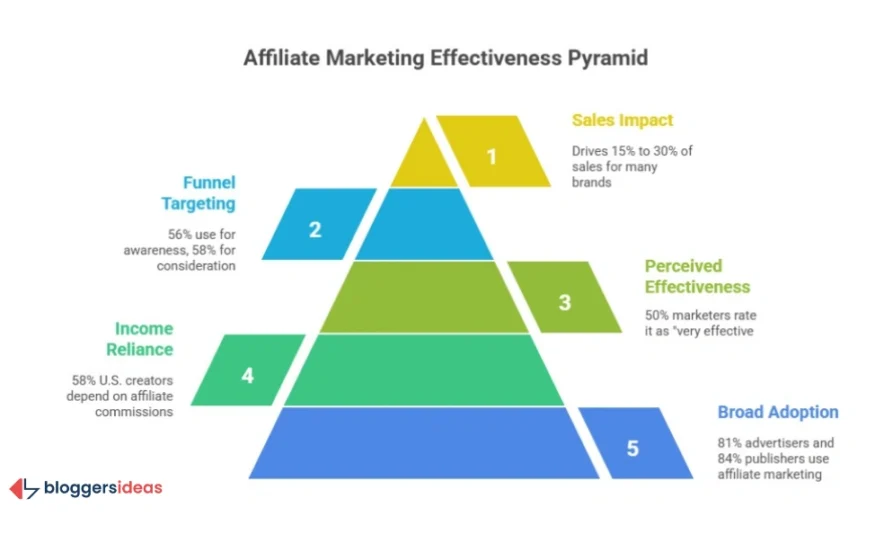
The affiliate sector accounts for 16% of all internet orders, with advertisers generating between 15% and 30% of all sales through affiliate programs. In the United States alone, 81% of marketers and 84% of publishers actively use affiliate marketing to boost brand awareness and drive sales.
America remains a dominant player, holding a 39% stake in the global affiliate marketing sector. Top coupon affiliate websites generate over $1 billion in revenue, showcasing the power of discount-driven affiliate models.
Furthermore, the United States hosts over 1.1 million Amazon sellers actively participating in the Amazon Associates program, underscoring the platform’s massive affiliate ecosystem.
Demographics and Operational Realities of Affiliate Marketers
The demographic profile of affiliate marketers provides valuable insights into the industry’s composition. Roughly 32% of affiliate marketers fall within the age range of 35 to 44, suggesting a mature and experienced demographic.
While the industry offers immense potential, approximately 95% of affiliate marketers unfortunately fail and quit, highlighting the challenges and competitive nature of the field.
Geographically, 57% of affiliate marketers are based in the United States, 10% in Canada, and 2% in India, indicating a strong North American presence.
In terms of personal status, 34% of affiliate marketers are single, while 55% are married. The flexibility of affiliate marketing is evident in work arrangements: 54.28% of affiliate marketers work from home, with 19.21% working from an office.
A key characteristic of the industry is its Pareto distribution of success: roughly 10% of marketers account for approximately 90% of revenues in most affiliate systems.
When it comes to payments, direct payment options are preferred by almost 50% of affiliate marketers. PayPal is the primary payment channel for 19.16% of marketers, while a notable 69% of affiliates use Bitcoin (BTC), reflecting the growing adoption of cryptocurrencies in the industry.
Website performance is paramount for affiliate success. A significant 47% of site visitors expect a website to load in under 2 seconds. A delay of just one second in site loading time can lead to a 7% decrease in sales, and if a site takes over 3 seconds to load, it risks losing 40% of its potential clients. These statistics emphasize the critical importance of website optimization for maximizing affiliate revenues.
SaaS-based affiliate programs offer some of the highest commission rates in the market, typically paying affiliates 20% to 70%.
The influence of social media on purchasing decisions is undeniable, with over 80% of social media users reporting they would read brand reviews before making a purchase. In terms of gender distribution, 54% of affiliate marketers are male, 43% are female, and 3% identify as other genders.
Here is a table showcasing the gender split of affiliate marketers:
| Gender | Share |
| Males | 54% |
| Females | 43% |
| Others | 3% |
Battling Affiliate Marketing Fraud
A significant concern within the affiliate marketing industry is the pervasive issue of fraud, which costs marketers billions of dollars annually.
Approximately 40% of affiliate marketing traffic is estimated to be fraudulent. A survey of affiliate marketers found that 63% are concerned about fraud, and a substantial 30.9% admitted to experiencing it in the past.
This highlights the urgent need for robust fraud detection and prevention measures within the ecosystem. Affiliate marketers are likely to lose an estimated $1.5 billion to fraud, a figure that could potentially increase with the sophisticated use of AI in fraudulent activities.
In 2022, fraudulent clicks accounted for 17% of affiliate traffic, costing companies an estimated $3.4 billion, part of a wider $23 billion ad fraud across various advertising and marketing channels.
Miscellaneous Statistics and Industry Growth Drivers
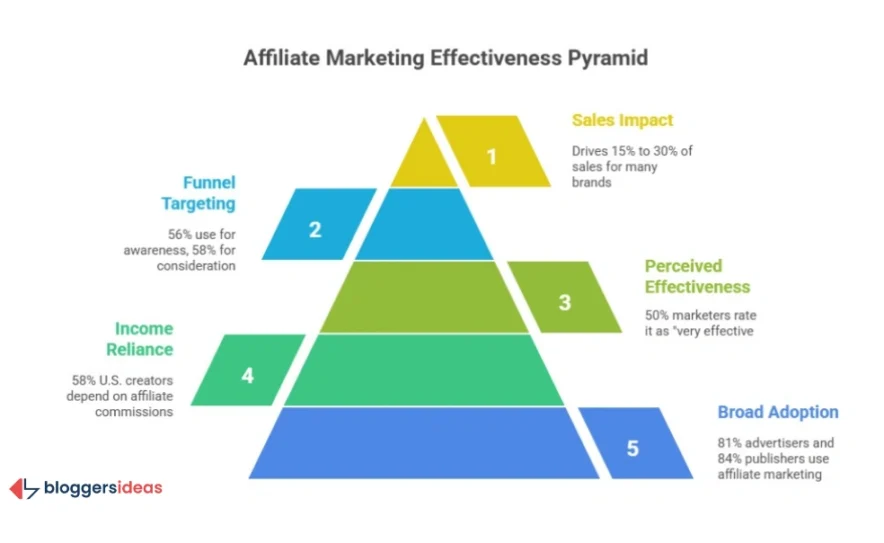
The affiliate marketing sector demonstrates strong financial confidence and consistent growth. An impressive 65% of CFOs planned to increase their investment in affiliate marketing, indicating a strategic prioritization of this channel.
Many affiliate networks report a surge in investment and marketing activity; for example, Amazon saw a 150% increase in advertisers in July 2020. The overall revenue of the affiliate marketing sector expands by 10% each year, a trend that has been consistent since 2015 and is expected to continue.
This sustained growth signals a healthy, expanding industry with growing opportunities for professionals and agencies.
Affiliate marketing is a highly effective customer acquisition channel for many brands. A survey of 178 affiliate directors and marketers found that 20% of brand marketers consider affiliate marketing their most important customer acquisition channel.
Here is a table detailing the most important customer acquisition channels:
| Marketing Channel | Share Of Votes |
| Affiliate Marketing | 20% |
| Paid and Organic Search | 16% |
| Display Advertising | 15% |
| Word Of Mouth | 13% |
| Retail Advertising | 13% |
| Paid Social Media | 12% |
| Press Release & Influencer Marketing | 11% |
Affiliate marketing drives around 16% of e-commerce sales in both the United States and Canada, two of the world’s largest e-commerce markets. Brand affiliates provide a subtle yet powerful way for brands to connect with customers, as their followers often trust their content and recommendations.
Notably, Shopify powers 2.7 million e-commerce websites in the United States, providing a massive ecosystem for affiliate opportunities.
More than 81% of advertisers utilize affiliate marketing, with reports from Rakuten Affiliate Network indicating that these programs contribute approximately 20% of their annual income. Mobile devices account for more than half of all affiliate referral traffic, underscoring the critical need for mobile optimization to enhance the user experience and capture more visitors.
Affiliate marketing accounts for 15% of all online media profits, indicating its substantial contribution to digital publishers’ revenue streams.
This signifies that publishers have become a crucial component of the purchasing funnel, offering a less expensive way for businesses to acquire new leads and customers than traditional advertising.
Blogging remains a primary traffic generation channel for affiliate marketers, with approximately 65% using it. Additionally, 69.22% utilize SEO, and 67.32% leverage social networking sites.
Instagram plays a significant role in affiliate marketing, with around 14% of Instagram affiliate marketers operating in the lifestyle niche. Other top niches on Instagram include travel, beauty, fashion, health and fitness, parenting, and motivation. B2C affiliate programs are the most common, accounting for 59.32% of all affiliate programs used by marketers.
A remarkable 76% of content providers believe affiliate marketing has simplified monetization, leading to their enthusiasm for these programs.
Furthermore, 45% of website owners assert that integrating affiliate links into their blogs does not detract from the user experience. Many affiliate marketers (24.46%) locate affiliate programs directly on the merchant’s website, while 19.21% use search engines and 17.52% browse affiliate network websites.
Social media networks are indispensable for connecting with potential consumers, with over 65% of marketers using them. Given Facebook’s over 3.03 billion users and Instagram’s over 2.3 billion active users, it is no surprise that these platforms are favored.
Approximately 75.8% of affiliate marketers prefer Facebook, and 61.4% prefer Instagram. Other popular platforms include Pinterest (42.2%), YouTube (36.9%), Twitter (31.1%), TikTok (29.6%), and LinkedIn (19%). On average, an affiliate marketer uses 3.03 social media platforms.
Approximately 65% of retailers report annual revenue of up to 20% from affiliate marketing, with nearly 60% of merchants generating $5 million or more in earnings through smart spending. Optimistically, more than 80% of marketers anticipate an increase in income, underscoring the effectiveness and reliability of affiliate marketing.
Furthermore, 90% of retailers plan to maintain or increase affiliate marketing expenses. The scope of affiliate marketing has expanded beyond physical products to include software, e-books, and digital courses, offering diverse opportunities.
About 9% of affiliate marketers earn more than $50,000 per year, and a small percentage earn even higher, reaching figures upwards of $1.5 million annually. While exact predictions are challenging, successful marketers like Neil Patel suggest annual earnings can range from $10,000 to $400,000.
In the United Kingdom, the average affiliate marketing revenue is around £35,000 per year, with self-employed marketers likely earning significantly more. The United States continues to dominate the global affiliate marketing business with a 39% share, followed by the United Kingdom (15%) and Germany (11%).
Emerging Trends: AI, Voice Search, and the Metaverse
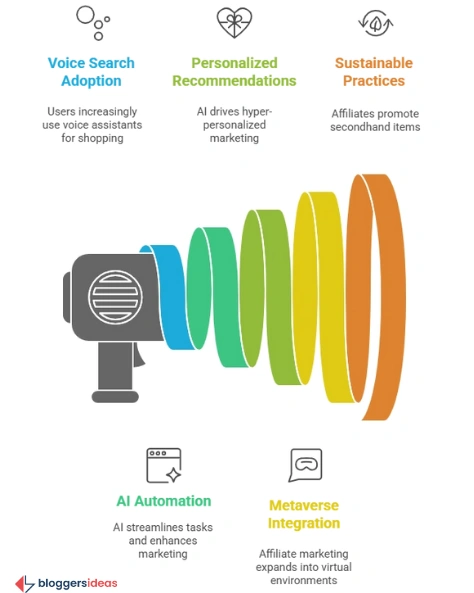
The future of affiliate marketing is intertwined with technological advancements. Artificial intelligence (AI) and voice search are the next big trends to watch. Over 72% of smartphone users engage with voice assistants daily, and nearly 40 million people in the United States own a smart speaker.
Projections indicate 8.4 billion voice assistants globally, with 43% of smart speaker owners using voice search for shopping. This presents new avenues for affiliates to optimize content for voice queries. AI is also poised to automate tasks such as lead generation, customer support, and personalized marketing campaigns, and to enhance ad targeting, making affiliate efforts more efficient.
Affiliate marketing in 2025 is also characterized by hyper-personalized recommendations driven by AI, collaborations with nano-influencers for authentic engagement, and mobile-first content creation. Cross-device tracking is more critical than ever, allowing affiliates to understand user journeys across multiple devices and refine their targeting.
Video and podcast content are highly prioritized, with brands actively seeking affiliates who create engaging multimedia content optimized for long-tail search terms.
The Metaverse is emerging as a new frontier for affiliate marketing, offering opportunities to promote products and services in virtual environments as more people engage with this immersive world.
Affiliate partnerships are on the rise, with two or more affiliates collaborating to promote products, thereby broadening reach and spreading campaign risk.
A significant and growing trend is the rise of affiliate programs for secondhand items. With the global market for secondhand clothes alone projected to reach $350 billion by 2027, affiliates are recognizing and capitalizing on the immense potential of promoting sustainable, pre-owned goods.
Quora & Reddit Insights: The Unspoken Questions of Affiliate Marketing
Beyond the data, the candid discussions on platforms like Quora and Reddit offer a real-time pulse of what aspiring and active affiliate marketers are truly grappling with. These online communities reveal a consistent demand for practical, experience-driven advice that often goes beyond what official reports capture.
A frequently asked question on these platforms centers around finding untapped or less saturated niches. With many popular niches appearing competitive, users are constantly searching for emerging product categories or underserved audiences where they can establish themselves more easily.
This indicates a desire to avoid direct competition with established “super affiliates” and find unique angles for promotion. They often ask for advice on conducting thorough niche research beyond simply looking at commission rates.
Another significant area of inquiry pertains to building trust and credibility as an affiliate. Users frequently ask how to avoid sounding like a “salesperson” and instead become a genuine, trusted resource for their audience.
This includes discussions of ethical review practices, transparency in disclosing affiliate relationships, and strategies for providing authentic value beyond mere product recommendations. This concern often stems from the prevalence of low-quality, spammy affiliate content that has eroded consumer trust.
There is also substantial interest in the longevity and future-proofing of affiliate income streams. Given the volatility of online trends and algorithm changes, users want to know how to build sustainable affiliate businesses that are not dependent on a single platform (like Amazon Associates) or a single traffic source (like SEO).
Questions arise about diversifying income, building an email list, and creating owned assets that can weather market shifts. This reflects a desire for long-term stability rather than quick, fleeting gains.
Finally, a common theme involves the legal and tax implications of affiliate marketing. As more individuals enter the space, they seek guidance on properly structuring their affiliate businesses, reporting earnings, and navigating international tax laws, especially if they are promoting products globally.
This practical concern often goes unaddressed in broad industry statistics but is critical for individual success and compliance.
FAQs About Affiliate Marketing
1. What is the projected market size of affiliate marketing in 2025 and beyond?
The affiliate marketing industry is valued at $17 billion in 2025 and is expected to reach $27.78 billion by 2027 and $38.35 billion by 2030, driven by growing advertiser investment and publisher participation.
2. How do AI and voice search impact affiliate marketing in 2025?
AI automates lead generation, personalizes campaigns, and improves targeting, while voice search, used by over 72% of smartphone users, creates new opportunities to optimize content for smart devices and conversational queries.
3. Which channels work best for affiliate marketing in 2025?
Blogs and SEO lead, with 65% of affiliates using blogs and 80% relying on SEO. Social media also plays a big role—Facebook (75.8%) and Instagram (61.4%) dominate—while mobile devices drive 50% of affiliate traffic.
4. What are the main challenges and opportunities in affiliate marketing?
Fraud, affecting up to 40% of traffic, and high beginner dropout rates remain challenges. Yet, growing investment, 10% annual revenue growth, and emerging opportunities in AI, the Metaverse, and eco-focused programs make the future promising for adaptable marketers.
Also Read:
- Infographics Statistics
- Tinder Statistics
- Personalization Statistics
- Meta AI Statistics
- Google Gemini Statistics
- Link Building Statistics
Conclusion: A Dynamic Future for Affiliate Marketing
The affiliate marketing industry in 2025 is not just growing; it is evolving at an unprecedented pace, demonstrating its resilience, profitability, and adaptability within the broader digital marketing landscape.
With projections indicating a market size of $27.78 billion by 2027 and potentially $38.35 billion by 2030, this strategy is clearly a cornerstone of future marketing endeavors. The widespread adoption by brands, the significant contribution to e-commerce sales, and the impressive earning potential for affiliates underscore its vital role.
From data-driven strategies and personalized recommendations powered by AI to collaborations with nano-influencers and the exploration of new frontiers like the Metaverse, the industry is embracing innovation.
While challenges like fraud and the high attrition rate for beginners persist, the continuous development of tools, the diversification of niches, and the strategic integration with other digital marketing channels offer immense opportunities.
For individuals and businesses looking to capitalize on online growth, understanding and strategically engaging with affiliate marketing is no longer an option but a necessity. The future of marketing is undeniably collaborative, digital, and deeply rooted in the power of affiliate partnerships.
