

A new Ahrefs study analyzing 331,000 pages has found no evidence that Google penalizes content simply because it was written by AI. The research, led by Ryan Law, challenges a widely held belief in the SEO world that AI-generated pages face an automatic ranking disadvantage.
The team pulled roughly one million pages from the top 10 positions across 100,000 search results in June 2026, with about 150,000 containing enough content for AI detection analysis. What they found complicates the simple “AI hurts rankings” narrative that has circulated for months.
What the Numbers Actually Show
Fully AI-generated pages are ranking in the top three positions right now. The study found 5.3% of top-3 pages are 100% AI-generated, and 9% carry 80% or more AI content.
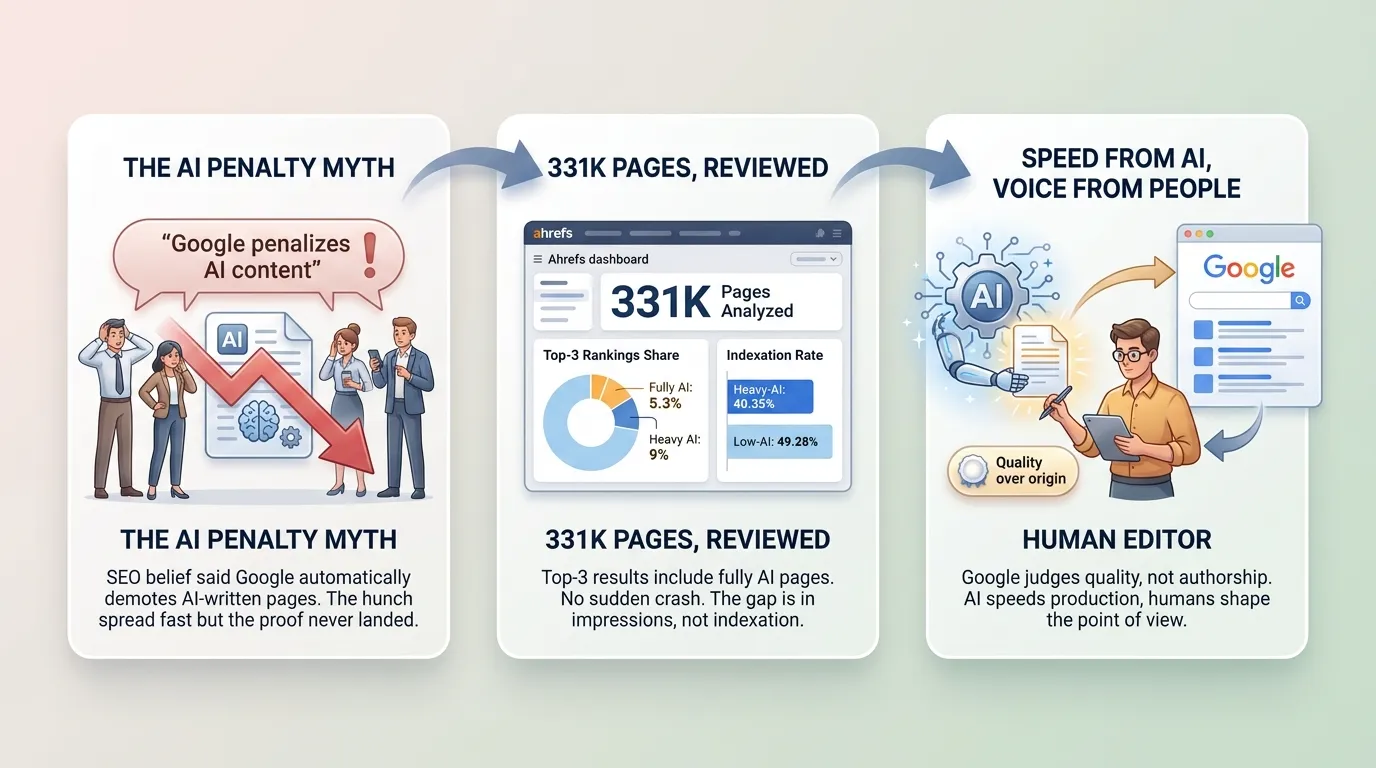
Indexation rates tell a similar story: pages with heavy AI content get indexed at 40.35%, compared to 49.28% for low-AI pages. That’s a real gap, but far from a wall blocking AI content from Google’s index entirely.
The much-discussed “Mount AI” pattern, where AI-heavy sites supposedly spike then crash, doesn’t show up in the data either. High-AI-content pages get stable impressions over time, with no sudden cliff.
The real divide is that low and moderate AI-content pages pull in two to three times the organic impressions that high-AI-content pages get, the sharpest performance gap the study found.
Ahrefs’ takeaway is that Google isn’t running an AI detector and penalizing anything it flags. It’s applying the same quality signals it always has. AI content simply tends to be thinner, more generic, and more error-prone on average, which is a correlation with lower performance, not a direct cause.
A Pattern Marketers Are Already Using
The findings echo what some marketing teams have been building around for a while. Sharda Mitra Dubey, who leads marketing at Stello AI, described running a partially AI-powered production system combining Claude and Ahrefs for research, briefs, drafting, and optimization, cutting content creation time by close to 70%.
The system still relies on human judgment to shape a bot-generated draft into something genuinely useful and to drive distribution.
The broader point lines up with Ahrefs’ data: speed comes from AI, but a point of view still has to come from a person. That part, so far, hasn’t been automated.
Quick Links:
Last updated

Affiliate disclosure: In full transparency – some of the links on our website are affiliate links, if you use them to make a purchase we will earn a commission at no additional cost for you (none whatsoever!).



Discussion
Join the conversation
No comments yet. Start the discussion with a question or your own experience.