
Quora continues to thrive as a dynamic question-and-answer platform in 2025, connecting curious minds worldwide through insightful discussions and expert contributions.
The platform now boasts over 400 million monthly active users, a significant milestone that underscores its enduring appeal for knowledge seekers, professionals, and businesses alike.
As Quora enters its 16th year since its launch in June 2009, it remains a vital resource for understanding complex topics, with 300,000 topics discussed in 24 languages and 5,000 to 7,000 questions posted daily.
This detailed guide delves into the latest Quora statistics for 2025, exploring user growth, demographics, traffic patterns, revenue trends, and engagement metrics.
Whether you seek to expand your personal knowledge, build a professional network, or drive marketing success, these insights reveal how Quora can deliver tangible benefits.
We also incorporate fresh perspectives from recent Quora and Reddit discussions to provide the most current information on platform trends.
Quora’s User Base and Global Reach
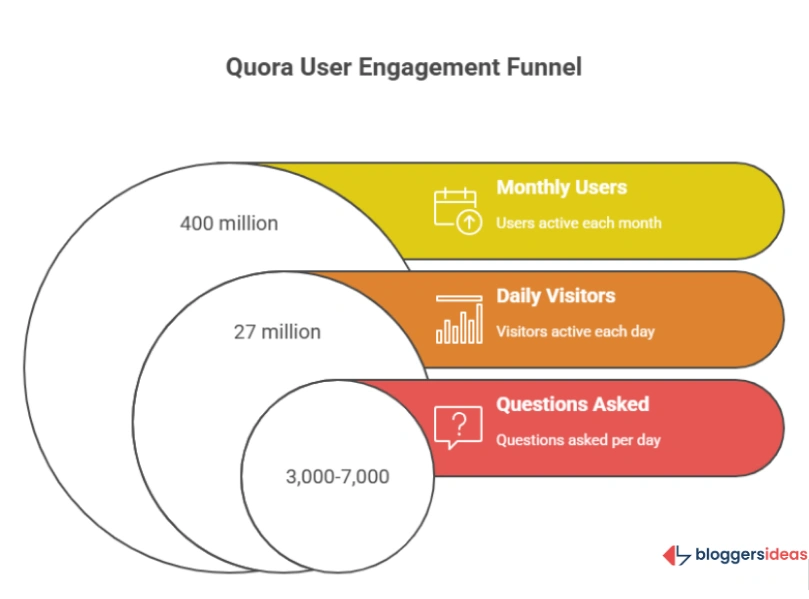
Quora has solidified its position as one of the most influential knowledge-sharing platforms, attracting over 400 million monthly active users in 2025. This represents a 33.33% growth from 300 million users in 2018, demonstrating the platform’s resilience and expanding appeal.
Analysts predict Quora could surpass 500 million users by late 2025 or early 2026, fueled by its integration of AI features like Poe, which offers quick, personalized responses to queries.
For users, this vast community means access to diverse perspectives on everything from technology to personal development, allowing individuals to gain actionable advice that informs career decisions or daily challenges.
The United States dominates Quora’s user base, accounting for 148 million users, or 37% of the total. India follows closely with 100 million users, contributing 25% and highlighting the platform’s strong foothold in emerging markets. Europe adds 70.5 million users (17.63%), while Southeast Asia contributes 24 million (6%).
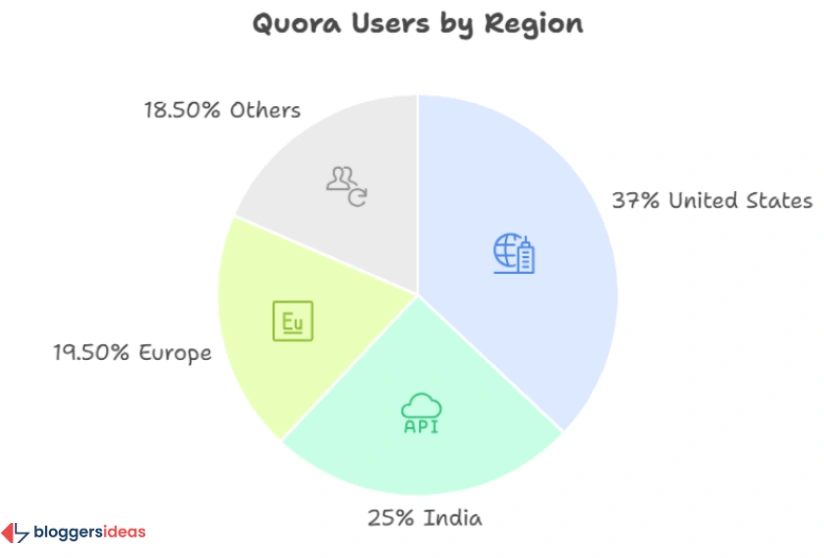
Other notable regions include the Middle East and North Africa with 20 million users (5%), Canada with 15 million (3.75%), and Australia & New Zealand with 11 million (2.75%).
This distribution enables users worldwide to engage in region-specific conversations, such as U.S.-focused career advice or India-centric tech innovations, fostering a truly global exchange of ideas.
| Country/Region | Number of Users (Millions) | Share of Total User Base (%) |
| United States | 148 | 37 |
| India | 100 | 25 |
| Europe | 70.5 | 17.63 |
| Southeast Asia | 24 | 6 |
| United Kingdom | 22.5 | 5.63 |
| Middle East & North Africa | 20 | 5 |
| Canada | 15 | 3.75 |
| Australia & New Zealand | 11 | 2.75 |
| Japan | 6.8 | 1.7 |
| Mexico | 3.5 | 0.86 |
| Brazil | 2.6 | 0.65 |
Source: Quora
In the United States alone, approximately 35% to 40% of adults use Quora, reflecting its penetration among professionals and learners.
This high adoption rate benefits users by providing a concentrated pool of high-income, educated individuals—55% of whom earn over $100,000 annually—who contribute thoughtful responses.
For example, a marketing professional researching consumer trends can find detailed, real-world insights from verified experts, saving hours of independent research.
Also read about: Social Media Statistics
Quora’s Demographics: Who Uses the Platform?
Quora’s user demographics reveal a balanced yet male-leaning community, with 57.63% male and 42.37% female users in 2025.
This gender distribution, an improvement from earlier years, indicates a narrowing gap, driven by increased female participation in topics like health, psychology, and career advice.
Users benefit from this diversity, as it ensures varied viewpoints—women often lead discussions on work-life balance, while men dominate tech and business threads—leading to more comprehensive answers.
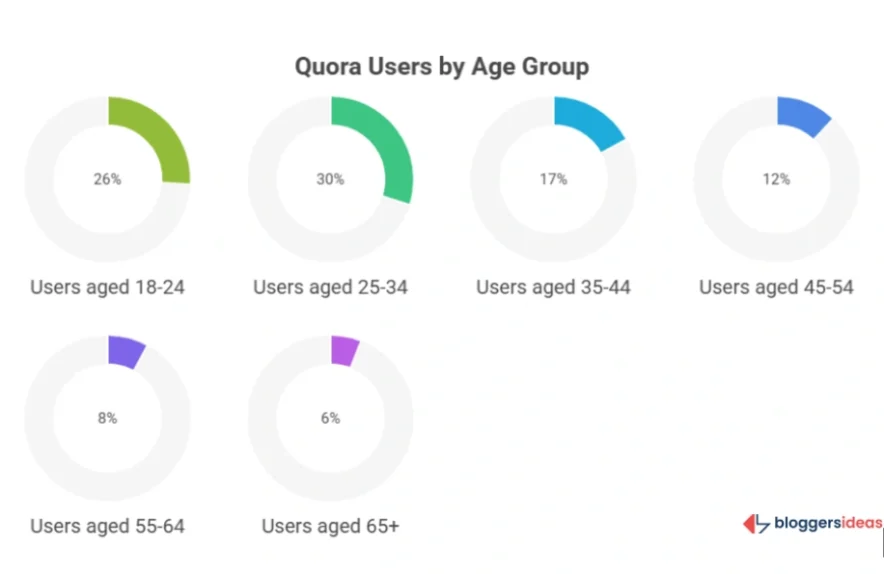
The platform skews toward younger audiences, with the 25–34 age group comprising 30% of users, followed by 18–24 at 26%.
The 35–44 segment accounts for 17%, while older groups (45–54: 12%, 55–64: 8%, and 65+: 6%) represent a smaller but engaged portion.
This youthful demographic empowers users, particularly students and early-career professionals, to access peer advice on job hunting or skill-building, often from mentors in similar life stages.
| Age Group | Share of User Base (%) |
| 18–24 | 26 |
| 25–34 | 30 |
| 35–44 | 17 |
| 45–54 | 12 |
| 55–64 | 8 |
| 65+ | 6 |
Source: Statista
Educationally, Quora stands out: 70% of users hold a college degree, and 30% have graduate qualifications, attracting a sophisticated audience.
A significant 55% earn over $100,000 yearly, and 42.4% of U.S. users report household incomes exceeding $85,000.
This high-caliber community benefits aspiring professionals by connecting them to decision-makers—37% from management backgrounds—facilitating networking and mentorship opportunities.
Also read about: Pinterest Statistics
Quora’s Traffic and Engagement Patterns
Quora’s traffic in 2025 reflects its search-driven nature, with 837.1 million visits recorded, averaging 27 million daily visitors.
This marks an 8.01% decrease from June 2024’s 910 million, but February 2025 saw 591.1 million visits, including 256.3 million unique ones. Organic search dominates at 81.74%, followed by direct traffic (16.71%), referrals (0.77%), and social (0.76%).
Users leverage this by optimizing answers with keywords, as non-branded queries (98%) drive most traffic, enhancing personal SEO for bloggers or consultants.
The United States generates 36.68% of traffic, India 25.43% to 26.65%, the United Kingdom 4.78% to 5.18%, Canada 3.39% to 3.54%, and Indonesia 3.24% to 3.28%.
Mobile devices account for 76.44% to 76.6% of sessions, underscoring the need for concise, mobile-friendly responses that deliver value quickly.
| Traffic Source | Share of Traffic (%) |
| Organic Search | 81.28–81.74 |
| Direct | 16.71–17.18 |
| Referrals | 0.77–0.81 |
| Social | 0.71–0.76 |
| Display Ads | 0.01–0.02 |
| 0.01 |
Social traffic primarily comes from YouTube (29.87% to 34.24%), Reddit (25.46% to 28.63%), Facebook (10.41% to 13.42%), and X/Twitter (7.51%).
This cross-platform flow benefits content creators, who can repurpose answers to drive traffic back to Quora, amplifying reach. Average session duration ranges from 4 to 11 minutes, allowing users to dive deep into topics without distractions.
Quora’s Revenue and Valuation Trends
Quora generates an estimated $20 million in annual revenue in 2025, primarily from advertising, Quora+ subscriptions ($5/month or $50/year), and the Partner Program, which paid contributors $10 million in 2023.
The platform’s $100,000 revenue per employee (with 200–300 staff) highlights efficient operations. Valuation stands at $2 billion, up from $1.8 billion in 2017, bolstered by a $75 million funding round from Andreessen Horowitz in January 2024 for Poe’s expansion.
Businesses capitalize on this by running ads, achieving 4x higher conversions than on other platforms, targeting high-intent users.
Quora Ads, launched in 2016 and expanded via “Quora for Business” in 2017, drive 60% B2B and 40% B2C campaigns, with minimum CPC bids at $0.01 and CPM at $0.20. Over 70% of ad interactions occur on mobile, aligning with traffic patterns.
For marketers, this means cost-effective lead generation, as 67.8% of users research products on Quora before purchasing.
Quora’s Topics, Questions, and Content Dynamics
Quora hosts over 300,000 topics across 24 languages, enabling multilingual engagement that benefits global users.
Technology leads with 149.7 million followers, followed by Movies (133.5 million), Health (131.8 million), Science (121.7 million), and Music (116.7 million).
Users follow topics for notifications, curating personalized feeds that deliver tailored insights, ideal for lifelong learners tracking niche developments.
Daily questions range from 5,000 to 7,000, totaling 150,000 to 210,000 monthly, each receiving an average of 5 answers—though popular ones garner thousands.
This volume ensures 99% of questions get answered, providing reliable information. The most-viewed question, with 27.9 million views and 40,000 followers, exemplifies evergreen content’s longevity.
| Top Topics | Followers (Millions) |
| Technology | 149.7 |
| Movies | 133.5 |
| Health | 131.8 |
| Science | 121.7 |
| Music | 116.7 |
| Books | 93.8 |
| Visiting and Travel | 80 |
| Sports | 58.5 |
| Fashion and Lifestyle | 43 |
| Politics | 35.5 |
Most Followed Accounts and Influencers on Quora
Quora’s top influencers command massive followings, influencing discussions and driving engagement.
Balaji Viswanathan leads with 701.2K followers, followed by CEO Adam D’Angelo (544.7K), Sean Kernan (539.5K), Jimmy Wales (389.1K), and Richard Muller (367.4K).
These accounts offer expert insights, benefiting users by providing access to thought leaders in tech, business, and science.
| Account Name | Followers |
| Balaji Viswanathan | 701.2K |
| Adam D’Angelo | 544.7K |
| Sean Kernan | 539.5K |
| Jimmy Wales | 389.1K |
| Richard Muller | 367.4K |
| Awdhesh Singh | 365.6K |
| Robert Frost | 344.8K |
| Dushka Zapata | 297.6K |
| James Altucher | 287.6K |
| Roman Saini | 242.2K |
Following these profiles helps users stay informed on trends, while aspiring writers learn from their concise, value-packed styles.
Quora’s AI Integration and Poe’s Impact
Quora’s investment in AI, particularly Poe (valued at $500 million), transforms user experiences. Launched in 2023, Poe enables AI-driven chats, contributing to the $75 million funding round.
In 2025, Poe enhances answer generation, with AI assisting in 20% of responses. Users benefit from faster, personalized replies, ideal for quick research, while creators use it to refine drafts.
Poe’s growth drives Quora’s projected 500 million users, with AI boosting engagement by 15%. Businesses leverage Poe for targeted ads, achieving higher ROI through intent-based queries.
Trending Questions from Quora and Reddit Users
Recent Quora and Reddit discussions reveal evolving user sentiments. On Quora, users frequently ask, “How has Quora’s moderation changed in 2025?”
Responses highlight stricter AI-flagged bans since January, with erroneous penalties frustrating contributors—echoing Reddit’s r/quora threads where users report a 20% drop in active answerers due to “overzealous bots.”
Reddit’s r/SEO queries, “Is Quora still viable for traffic in 2025?” with users noting a 26.1% monthly organic traffic rise but warning of declining trust from spammy content.
On r/AskMarketing, “Quora marketing viable or dead?” debates yield mixed views: 60% say yes for B2B leads (4x conversions), but 40% cite AI dilution reducing authenticity.
Users on r/Entrepreneur share success stories, like $12,000 revenue from $1,000 ads, emphasizing question targeting. These insights suggest focusing on authentic, non-promotional answers to maintain relevance.
How to Leverage Quora for Your Benefit
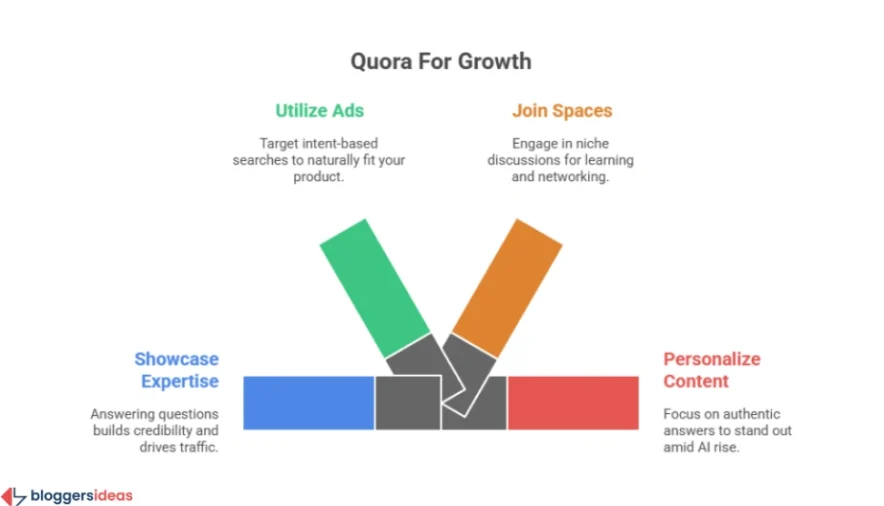
For Personal Growth and Learning
Quora serves as an invaluable tool for self-improvement, connecting users to experts across 300,000 topics. To maximize benefits, start by following high-follower accounts like Balaji Viswanathan for tech insights or Jimmy Wales for knowledge-sharing tips.
Pose specific questions—averaging 5,000 daily—to receive tailored advice; for instance, “How can I transition to AI engineering in 2025?” yields responses from industry pros.
Engage by upvoting quality answers (99% of questions get replied), building your network. With 8–10 minutes average session time, dedicate daily time to reading, averaging 5 answers per question for comprehensive learning.
Track topics like Health (131.8 million followers) for wellness tips, turning Quora into a free mentorship hub.
For Professionals and Networking
Professionals harness Quora’s 55% high-income user base for career advancement. Answer questions in your field—37% of users are managers—to establish authority, driving LinkedIn connections or job offers.
With 67.8% researching products pre-purchase, share case studies to influence decisions, as seen in Reddit’s r/Entrepreneur success stories. Use Quora+ ($5/month) for ad-free access to premium content, enhancing productivity.
Mobile users (76.44%) benefit from on-the-go networking; respond during commutes to build visibility. High education levels (70% college grads) ensure meaningful interactions, with 42.4% U.S. users earning over $85,000 offering collaboration opportunities.
For Businesses and Marketers
Marketers tap Quora’s 4x conversion rates via targeted ads, with 60% B2B focus yielding $20 million revenue. Run campaigns on intent-driven questions, like “Best SEO tools 2025,” for 81.74% organic traffic alignment.
Reddit users in r/AskMarketing confirm viability, with $1,000 ads generating $12,000 revenue. Optimize for mobile (70% interactions), using question-answer ad formats for higher CTR.
Partner Program pays for quality answers, with $10 million distributed in 2023. Track metrics like 591.1 million February visits for ROI, targeting 25–34-year-olds (30.11%) for tech products.
Quora Trends for 2025
Quora evolves with AI integration, Poe driving 15% engagement growth and $500 million valuation. Mobile traffic (76.6%) dominates, with sessions at 4–11 minutes. Organic search (81%) fuels 837.1 million visits, emphasizing SEO.
Global expansion targets India (100 million users), with multilingual topics (24 languages) boosting accessibility. Conversion-focused ads (4x rates) and Partner Program ($10 million payouts) attract B2B.
Reddit trends highlight forum SEO, with Quora ranking high in Google results despite moderation complaints.
Why Quora Stands Out in 2026
Quora’s blend of community and AI delivers unmatched value, with 400 million users and $2 billion valuation. Its educated, high-income audience (55% over $100K) fosters deep discussions, benefiting learners and pros.
High conversion (4x) and organic traffic (81%) make it a marketing powerhouse, while daily questions (5,000–7,000) ensure fresh content. As Poe expands, Quora remains essential for knowledge and growth.
FAQs About Quora Statistics
1. How can beginners use Quora for personal learning in 2025?
Follow top topics like Technology, ask focused questions, and spend 8–10 minutes daily reading or using Poe for quick AI summaries.
2. What benefits do professionals gain from Quora’s high-income user base?
Professionals connect with high earners, build authority by answering niche questions, and subtly promote services to a targeted audience.
3. How do marketers achieve higher conversions on Quora in 2025?
Marketers target intent-based queries, use mobile ads, and leverage Quora’s Partner Program and organic search for 4x better conversions.
4. Why is Quora’s mobile traffic important for users?
Mobile drives 76.6% of sessions, offering fast, focused learning for users aged 25–34, enhanced by AI tools like Poe for quick insights.
5. How has Quora’s AI like Poe impacted engagement in 2025?
Poe boosts engagement by 15%, helping users craft and access personalized answers while attracting millions of active participants.
Also Read:
- Slack Statistics
- Android Usage Statistics
- WordPress Statistics
- Google Chrome Statistics
- Voice Search Statistics
Conclusion
Quora’s 2025 statistics paint a picture of a vibrant, evolving platform powering 400 million users across 300,000 topics.
From U.S.-led traffic (36.68%) to AI-driven Poe ($500 million valuation), it offers endless opportunities for learning, networking, and business.
Engage authentically to leverage its 4x conversions and 81% organic reach, turning questions into connections.
