
In 2025, Slack continues to stand as one of the most influential tools shaping modern workplace communication.
With remote and hybrid work now standard practice, Slack’s combination of intuitive design, automation, and collaboration features keeps teams connected and productive.
This detailed overview highlights the latest Slack statistics for 2025, covering user growth, revenue, and its ongoing impact on organizational culture and productivity.
The Evolution of Slack
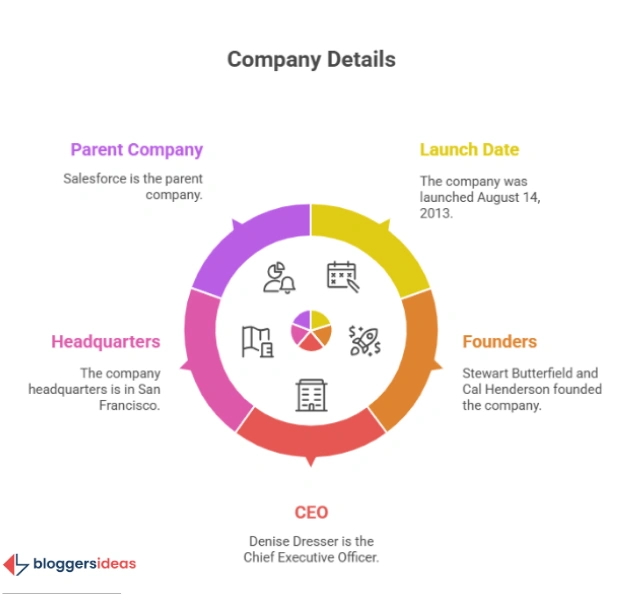
Slack’s journey began in 2011 as an internal messaging tool at Tiny Speck, a small game development company led by Stewart Butterfield, who had previously co-founded Flickr.
What started as a simple team chat tool for the game Glitch soon evolved into something far bigger. By 2012, Butterfield and his team shifted their focus entirely to developing Slack, recognizing its potential to transform workplace communication.
After launching publicly in 2014, Slack saw rapid adoption—8,000 requests for access on day one and 15,000 in its second week. By the end of its first year, it had achieved “unicorn” status with a valuation exceeding $1 billion, setting the stage for its rise as a major collaboration platform.
Slack User Growth in 2026
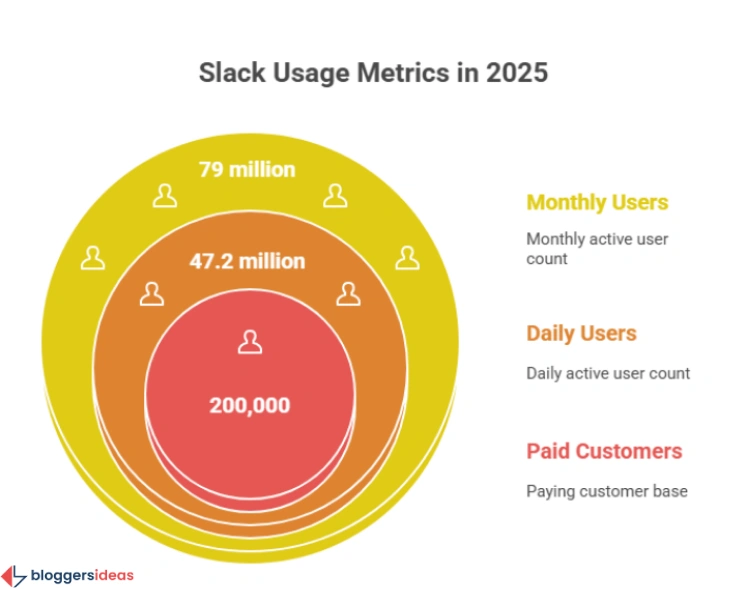
Slack’s user base continues to grow at an impressive pace. The platform now reports 47.2 million daily active users (DAU) in 2025, up from 8.7 million in 2019.
Monthly active users (MAU) are projected to reach 79 million, showing that engagement extends well beyond occasional use.
| Year | Daily Active Users | Monthly Active Users |
|---|---|---|
| 2025* | 47.2 million | 79 million |
| 2024 | 38.8 million | 65 million |
| 2023 | 32.3 million | 54.1 million |
| 2022 | 25.7 million | 43.1 million |
| 2021 | 19.2 million | 32.2 million |
| 2020 | 12.6 million | 21 million |
| 2019 | 8.7 million | 14.6 million |
Source: Statista.
Slack’s ongoing adoption proves it has become an essential part of everyday business operations, not just a tool for remote teams.
Slack’s Financial Growth
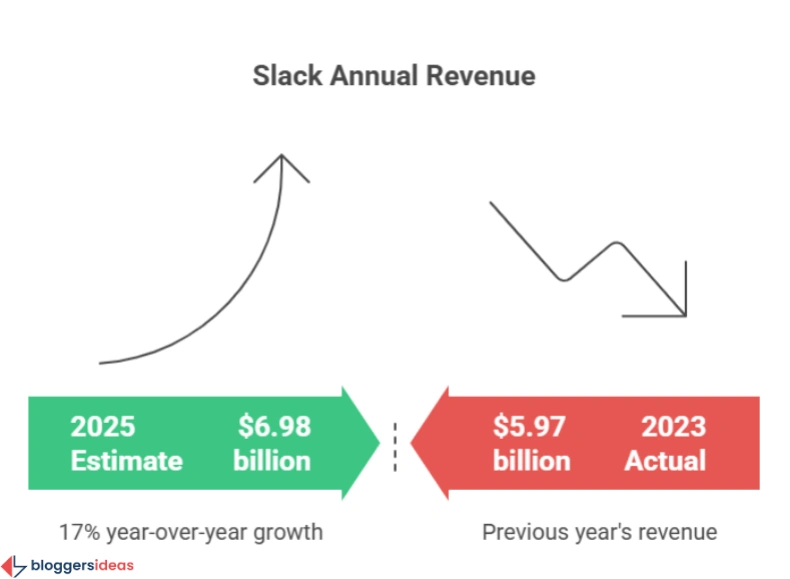
Slack’s revenue reflects its steady expansion. In 2025, annual revenue is estimated at $6.98 billion, up from $5.97 billion in 2023—a 17% year-over-year increase.
Since its acquisition by Salesforce in 2021, Slack’s results have been folded into Salesforce’s “Platform and Other” segment, yet it remains a major contributor to Salesforce’s overall performance.
| Year | Revenue |
|---|---|
| 2023 | $5,967 million |
| 2022 | $4,509 million |
| 2021 | $3,324 million |
| 2020 | $902.6 million |
| 2019 | $630.4 million |
| 2018 | $400.6 million |
Source: Business of Apps.
Slack’s financial health underscores its enduring relevance in a competitive market where workplace software demand keeps rising.
Organizational Adoption and Paid Customers
Slack’s influence now reaches over 750,000 organizations, including 77% of Fortune 100 companies such as IBM, Amazon, and PayPal. As of 2023, the number of organizations using Slack surpassed 1.1 million, showing growing enterprise adoption.
Its paying customer base is equally impressive, standing at 200,000 organizations, up 39% from the previous year. These premium clients benefit from added security, integrations, and administrative tools essential for large-scale collaboration.
| Year | Paying Customers |
|---|---|
| 2023 | 200,000 |
| 2022 | 169,000 |
| 2021 | 156,000 |
| 2020 | 112,000 |
| 2019 | 88,000 |
Also read about: Social Media Statistics
Engagement and Productivity on Slack
Slack isn’t just popular—it’s deeply embedded in daily workflows. Users spend over 90 minutes per day actively engaging on the platform, with 1.5 billion messages exchanged daily.
Roughly 1 billion weekly actions take place on mobile devices, confirming that Slack supports work anywhere, anytime.
Organizations report significant benefits:
- 87% say Slack improved internal communication quality.
- 74% of users communicate primarily through public channels, encouraging transparency.
- Companies using Slack report 32% fewer emails and 27% fewer meetings.
- Support teams reduce tickets by 2,500 per week through automation.
These results demonstrate Slack’s tangible impact on productivity and communication efficiency.
Productivity Boosts and Team Culture
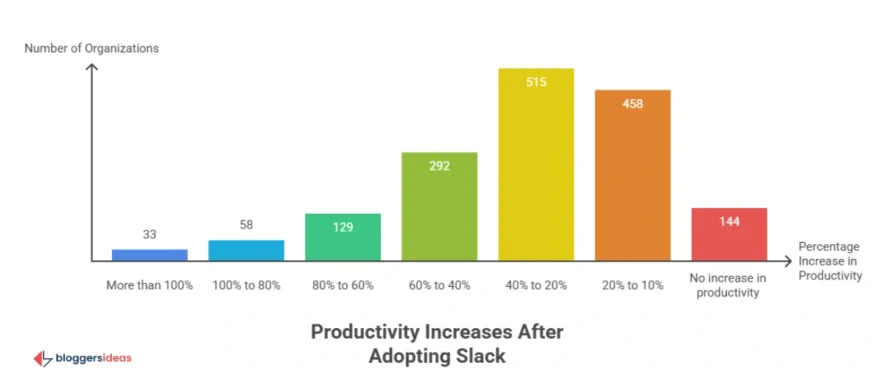
Slack isn’t just about messages—it’s about measurable performance. A study of over 500 organizations revealed that most saw a 20–40% productivity increase after adopting Slack. Some even doubled their efficiency.
| Productivity Increase | Number of Organizations |
|---|---|
| 100%+ | 33 |
| 80–100% | 58 |
| 60–80% | 129 |
| 40–60% | 292 |
| 20–40% | 515 |
| No increase | 144 |
Beyond productivity, 79% of organizations report improved team culture, while 91% say Slack enhances remote work effectiveness.
Also read about: WhatsApp Statistics
Market Valuation and Salesforce Integration
Slack’s market value remains strong at $26.51 billion in 2024, ranking it among the world’s top 800 companies by capitalization. Salesforce acquired Slack for $27.7 billion in 2020, a deal that underscored its strategic importance in enterprise collaboration.
| Year | Valuation |
|---|---|
| 2024 | $26.51 billion |
| 2020 | $27.7 billion |
| 2019 | $23 billion |
| 2018 | $7.1 billion |
| 2015 | $2.8 billion |
Slack’s Market Share
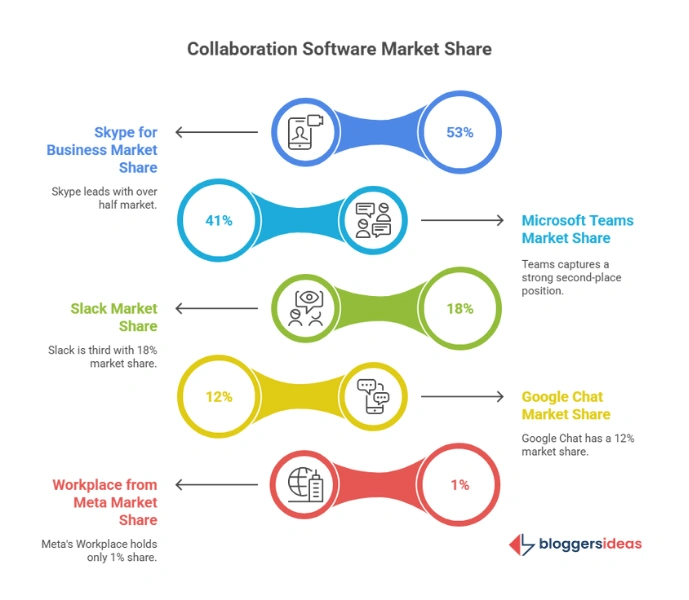
In 2025, Slack holds 18% of the business communication software market, competing mainly with Microsoft Teams and Skype for Business.
While Teams dominates with 41%, Slack remains the preferred choice for companies seeking flexibility and seamless integrations.
| Platform | Market Share |
|---|---|
| Skype for Business | 53% |
| Microsoft Teams | 41% |
| Slack | 18% |
| Google Chat | 12% |
Despite competition, Slack’s loyal user base and innovative features sustain its market presence.
Also read about: Gmail Statistics
Slack vs. Microsoft Teams
While both platforms enable team communication, their ecosystems differ. Microsoft Teams benefits from tight integration with Microsoft 365, while Slack offers greater flexibility and app integrations—over 2,000 apps and 750 bots.
| Parameter | Microsoft Teams | Slack |
|---|---|---|
| Monthly Active Users | 320 million | 54.1 million |
| Market Share | 41% | 18% |
| Estimated Revenue | $8 billion+ | $6.98 billion |
Slack’s niche strength lies in providing a user experience that encourages open communication and customization across diverse workflows.
Global Reach and Integrations
Slack operates in over 150 countries and supports 12 languages, enabling global collaboration across borders. Its App Directory houses more than 2,000 applications and 750 bots, allowing users to automate workflows with tools like Google Drive, Salesforce, Asana, and GitHub.
Over 500,000 developers contribute to Slack’s growing integration ecosystem, turning it into a comprehensive hub for digital collaboration.
Workforce and Diversity
Slack employs about 4,200 people across 11 offices in 7 countries, including major hubs in San Francisco, New York, London, Paris, Tokyo, and Melbourne. Gender diversity continues to improve, with 43.5% female employees in 2024, up from 42.6% in 2023.
| Year | Female Employees | Male Employees |
|---|---|---|
| 2024 | 43.5% | 56.5% |
| 2020 | 40.3% | 59.7% |
| 2017 | 36.1% | 63.9% |
Through initiatives like Slack for Good, the company promotes diversity and aims to expand opportunities for underrepresented groups in tech.
Funding and Financial Backing
By 2025, Slack’s total funding reached $35.8 billion, supported by major investors including Alphabet, Benchmark, and SoftBank Ventures.
| Year | Funding Total |
|---|---|
| 2025 | $35.8 billion |
| 2024 | $26.4 billion |
| 2020 | $21.4 billion |
| 2015 | $5.64 billion |
| 2011 | $0.06 billion |
This financial backing has fueled innovation, global expansion, and continued R&D investment.
Slack’s Growth within Salesforce
Under Salesforce’s ownership, Slack continues to evolve as a core part of the customer relationship management (CRM) ecosystem.
Salesforce’s integration allows users to connect directly with sales, service, and analytics tools through Slack’s channels—bridging communication and data in one workspace.
Revenue contribution remains strong within Salesforce’s “Platform and Other” segment, with Slack responsible for a significant share of its $6.98 billion expected in 2025.
Community Feedback and AI Evolution
Discussions on Quora and Reddit reveal growing user interest in deeper AI-powered features—such as automated meeting summaries, channel recommendations, and smarter workflow suggestions.
Users also emphasize the benefits of Slack Connect, which enables external collaboration between companies.
In 2025, advanced workflow automation remains a major theme, as teams seek to build multi-step workflows using Slack’s Workflow Builder with conditional logic to streamline repetitive tasks.
FAQs About Slack Statistics
1. What are the main benefits organizations gain from using Slack?
Slack improves communication, reduces emails and meetings, boosts productivity, and strengthens team culture. It also enhances remote work efficiency through real-time collaboration and integrations.
2. How has Slack's user base grown in recent years?
Slack’s daily active users rose from 8.7 million in 2019 to 47.2 million in 2025, driven by remote work adoption, intuitive design, and strong integration with other business tools.
3. What is Slack’s financial status after its acquisition by Salesforce?
Since Salesforce acquired Slack for $27.7 billion in 2021, its annual revenue has grown steadily, reaching about $6.98 billion in 2025, contributing significantly to Salesforce’s ecosystem.
4. How does Slack boost productivity and workplace culture?
Slack centralizes communication, automates workflows, and reduces meeting time. It promotes transparency and inclusivity, helping teams stay connected and productive across all work models.
5. What new features are users expecting from Slack in 2025?
Users seek deeper AI integration for meeting summaries and smart suggestions, better tools for managing Slack Connect, and advanced workflow automation with conditional logic.
Also Read:
- Tinder Statistics
- Marketing Automation Statistics
- Uber Statistics
- Zoom Statistics
- Google Gemini Statistics
Conclusion: The Future of Slack
Slack continues to play a central role in defining how teams communicate, innovate, and deliver results.
With its strong financial foundation, global presence, and dedication to user experience, Slack is more than a messaging app—it’s an all-in-one digital workspace built for the future of work.
As organizations embrace hybrid models, Slack’s ability to connect people, automate workflows, and foster transparency ensures it remains a key player in enterprise collaboration for years to come.
