
Google Chrome remains the undisputed heavyweight champion of web browsers, commanding an unparalleled share of the global internet landscape.
For individuals, businesses, and developers, understanding the latest Google Chrome statistics 2025 is crucial for optimizing digital strategies, enhancing user experience, and staying ahead in an ever-evolving online world.
This comprehensive article delves into Chrome’s formidable market presence, user demographics, extension ecosystem, and future trajectory, offering actionable insights for anyone looking to maximize their digital interactions.
Chrome’s Unmatched Dominance: A Global Overview
Since its public release in 2008, Google Chrome has consistently solidified its position as the leading browser worldwide.
Its swift adoption across various platforms—Microsoft Windows, macOS, Linux, and mobile devices—catapulted it to the top by mid-2012, a position it has held with unwavering consistency ever since.
User Base: Billions Strong and Growing
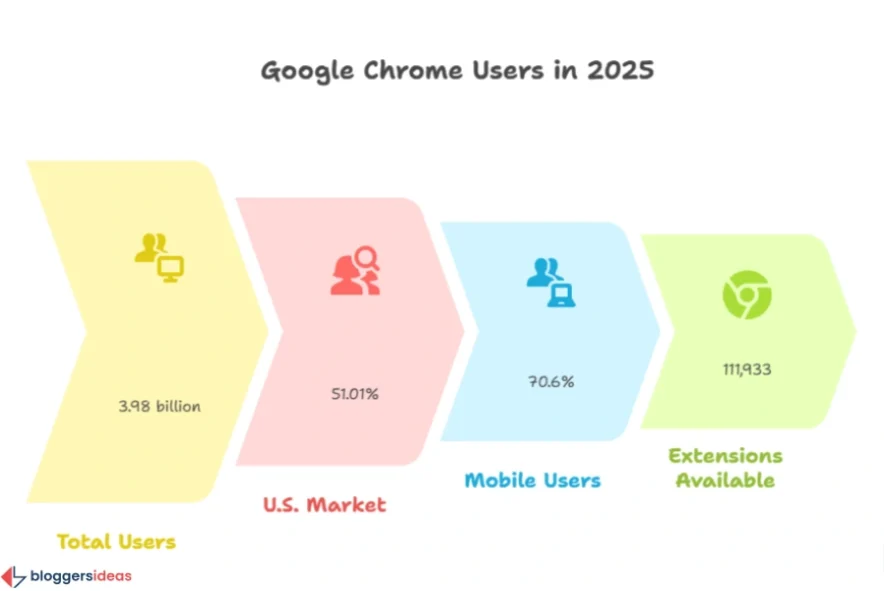
The sheer scale of Chrome’s user base is staggering. An estimated 3.98 billion internet users globally choose Chrome as their primary browser in 2025.
This figure represents a robust 5.8% increase compared to the previous year and a remarkable growth of 0.77 billion new users over the last five years, translating to an estimated 25.16% expansion since 2020.
This continuous growth underscores Chrome’s enduring appeal and its ability to attract new users in a competitive market.
The following table showcases Chrome’s impressive user growth over the past decade, demonstrating its consistent expansion.
| Year | Number of Chrome Users (Billions) |
| 2014 | 1.25 |
| 2015 | 1.5 |
| 2016 | 1.84 |
| 2017 | 2.04 |
| 2018 | 2.39 |
| 2019 | 2.74 |
| 2020 | 3.06 |
| 2021 | 3.23 |
| 2022 | 3.3 |
| 2023 | 3.45 |
| 2024 | 3.62 |
| 2025 | 3.98 |
Source: Statista
Global Market Share: A Commanding Lead
Chrome’s market share across all device types stands at an impressive 67.72% in 2025, a slight but significant increase from 65.82% in 2024.
This overwhelming dominance positions Chrome far ahead of its closest competitor, Safari, which holds a 16.64% market share.
This consistent leadership highlights Chrome’s successful strategy of continuous innovation, robust performance, and extensive platform compatibility.
The historical trajectory of Chrome’s market share vividly illustrates its journey to the top.
| Year | Chrome’s Market Share (All Device Types) |
| 2009 | 3.23% |
| 2010 | 9.95% |
| 2011 | 19.79% |
| 2012 | 29.3% |
| 2013 | 34.67% |
| 2014 | 38.94% |
| 2015 | 44.87% |
| 2016 | 49.08% |
| 2017 | 53.96% |
| 2018 | 59.12% |
| 2019 | 63.31% |
| 2020 | 64.6% |
| 2021 | 64.45% |
| 2022 | 64.78% |
| 2023 | 63.87% |
| 2024 | 65.82% |
| 2025 | 67.72% |
Source: StatCounter
Chrome Across Devices: Mobile, Desktop, and Tablet Insights
Chrome’s supremacy is not limited to a single device category; it extends across mobile, desktop, and tablet platforms, albeit with varying degrees of dominance.
Mobile Dominance: The Preferred Handheld Browser
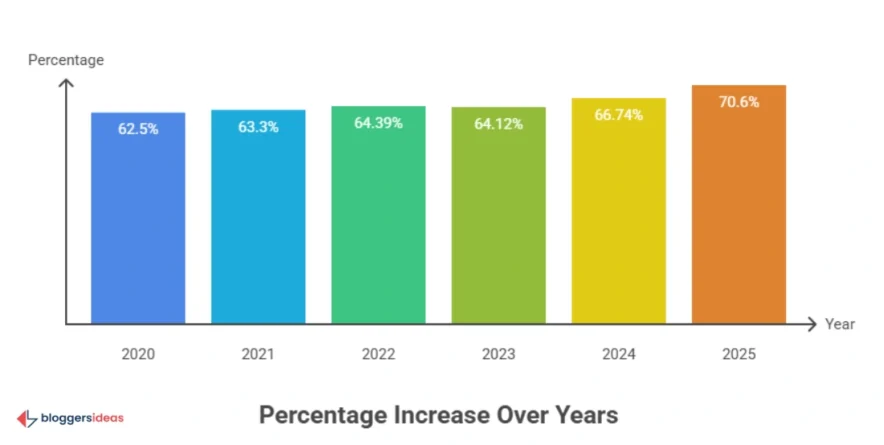
Globally, Chrome firmly controls the mobile browser market with a 68.34% share in 2025, a slight increase from 66.74% in 2024. Safari trails significantly, holding 23.02% of the mobile browser market.
This strong mobile presence is particularly crucial in an era where smartphone usage for internet access continues to surge, cementing Chrome’s role as the gateway to the internet for billions on the go.
The growth in Chrome’s mobile browser market share reflects the global shift towards mobile-first internet consumption.
| Year | Mobile Browser Market Share |
| 2012 | 0.35% |
| 2013 | 3.98% |
| 2014 | 21.25% |
| 2015 | 33.58% |
| 2016 | 38.38% |
| 2017 | 48.86% |
| 2018 | 54.14% |
| 2019 | 60.14% |
| 2020 | 62.5% |
| 2021 | 63.3% |
| 2022 | 64.39% |
| 2023 | 64.12% |
| 2024 | 66.74% |
| 2025 | 70.6% |
Chrome for Android stands out as the most popular version, accounting for 40.58% of the global browser market share, further underscoring its mobile strength.
Also read about: Most Google Searched Things Statistics
Desktop Leadership: Maintaining a Stronghold
On desktop platforms, Chrome also maintains a commanding lead, holding a 64.87% global share. Edge comes in a distant second at 13.78%.
This sustained dominance on traditional computing devices highlights Chrome’s versatility and its ability to cater to a broad spectrum of user needs, from casual browsing to intensive professional tasks.
Tablet Performance: Still the Leader
While Chrome’s market share on tablets is its lowest among all device types (excluding game consoles) at 48.69% in 2025, it still secures the top spot.
Safari ranks second among tablet browsers, with a 31.19% market share.
The lower tablet share suggests a more competitive landscape in this niche, but Chrome’s leading position remains unchallenged.
Chrome in the United States: A Highly Competitive Landscape
While Chrome enjoys overwhelming global dominance, its market share in the United States presents a slightly different picture, reflecting a more competitive domestic environment.
Overall US Market Share: Still Number One
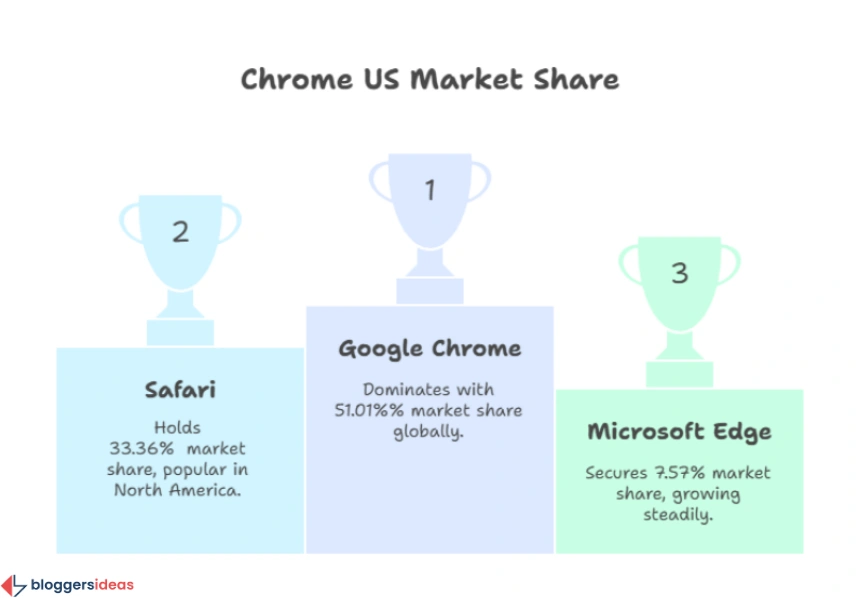
In the United States, Chrome holds an impressive 51.01% share of the browser market, making it the leading browser despite stronger competition.
Safari remains a formidable contender in the US, securing a substantial 33.36% market share. Chrome’s consistent presence above 50% in the US market over recent years demonstrates its strong user base and brand loyalty among American internet users.
The historical data on Chrome’s market share in the US illustrates its sustained leadership.
| Year | Chrome’s Market Share (US) |
| 2009 | 2.99% |
| 2010 | 8.58% |
| 2011 | 14.92% |
| 2012 | 20.81% |
| 2013 | 26.65% |
| 2014 | 31.36% |
| 2015 | 38.38% |
| 2016 | 43.4% |
| 2017 | 45.27% |
| 2018 | 49.4% |
| 2019 | 49.39% |
| 2020 | 46.93% |
| 2021 | 48.48% |
| 2022 | 49.78% |
| 2023 | 49.97% |
| 2024 | 52.41% |
| 2025 | 52.23% |
Desktop Dominance in the US: A Clear Winner
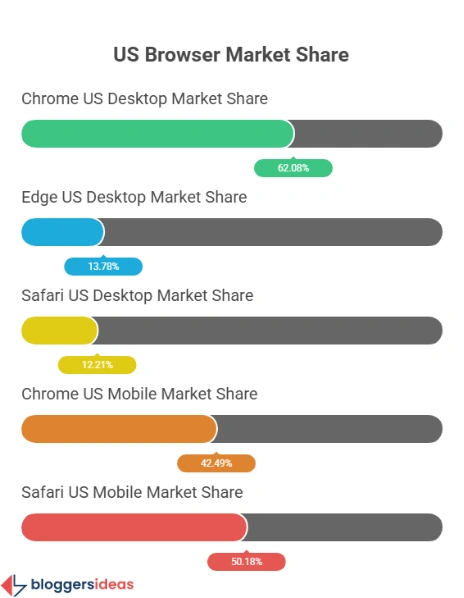
Chrome holds a clear majority in the US desktop search market with 62.08% market share.
Edge, its closest competitor, holds a market share over four times smaller at 13.78%, with Safari ranking third at 12.21%. This signifies Chrome’s strong preference among desktop users in the United States.
Mobile Competition in the US: Safari’s Stronghold
Within the mobile category in the US, Chrome has a usage share of 42.49%, positioning it as the second most popular mobile browser.
Safari leads the way on mobile with a formidable 50.18% market share, largely due to its integration with Apple’s iOS ecosystem. This highlights the fierce competition in the US mobile browser market, where platform integration plays a significant role.
Also read about: Chrome Feature Update Tackles Notification Overload
Chrome Extensions: Enhancing Functionality and Productivity
A cornerstone of Chrome’s appeal lies in its extensive ecosystem of extensions, which allow users to customize and enhance their browsing experience.
Vast Extension Library: A World of Possibilities
As of August 2024, there are 111,933 Chrome extensions available on the Chrome Web Store, though this number is down from 137,345 in May 2020.
This vast library caters to almost every conceivable need, significantly boosting Chrome’s utility and user satisfaction. Over half (55.5%) of these extensions fall under the productivity category, underscoring users’ desire to streamline their workflows and accomplish more online.
Despite the large number, a significant portion of extensions have a limited user base; 95,136 Chrome extensions (85%) have fewer than 1,000 users.
Conversely, only 2,000 (1.8%) boast more than 100,000 users, and a mere 242 extensions (0.22%) have more than 1 million users. Google itself develops 16 Chrome extensions, with 8 of these having over 1 million users, showcasing their utility and broad appeal.
Chrome App Downloads and Ratings: Mobile User Engagement
Chrome’s mobile application enjoys immense popularity, reflected in its download numbers and user ratings.
Billions of Downloads: A Mobile Phenomenon
The Google Chrome mobile app has been downloaded an astounding 83.89 million times across iOS and Android platforms as of September 2025. It achieved the remarkable milestone of over 10 billion lifetime downloads on Google Play in December 2021.
This makes Google Chrome the second most downloaded free Android app globally on the Google Play Store, trailing only YouTube.
This phenomenal download rate—0.6% monthly and 1.2% every two months—underscores its pervasive presence in the mobile computing landscape.
High User Satisfaction: Strong Ratings
With an average rating of 4.11 from more than 42.48 million users on the Google Play App, Chrome consistently demonstrates high user satisfaction.
While WhatsApp leads in the number of ratings (over 176.07 million), Chrome’s strong average rating from tens of millions of users reflects its reliability and positive user experience.
What Users Are Asking: Emerging Trends and Insights
Beyond raw statistics, popular online forums like Quora and Reddit offer invaluable insights into what users are thinking, questioning, and hoping for regarding Google Chrome.
Many users frequently ask about Chrome’s memory and CPU usage, particularly with multiple tabs and extensions, indicating a persistent desire for better performance and resource management.
Another common query revolves around data privacy and security, especially concerning Google’s tracking practices, reflecting growing public awareness and concern.
Users also often seek advice on managing their digital footprint within Chrome and explore alternative privacy-focused browsers.
Furthermore, there’s a recurring interest in the future of Chrome’s ad-blocking capabilities and how Google plans to balance user privacy with its advertising business model. These discussions highlight a collective push for a faster, more private, and resource-efficient browsing experience.
FAQs About Google Chrome Statistics
1. How many people use Google Chrome, and what’s its market share in 2025?
About 3.83 billion users rely on Chrome in 2025, giving it a 67.72% global market share, making it the top browser worldwide.
2. Does Chrome dominate both desktop and mobile browsing?
Yes. Chrome holds 64.87% of the desktop market and 68.34% of the mobile market, leading across all major platforms.
3. How many Chrome extensions exist, and which are most popular?
There are 111,933 extensions, with 55.5% focused on productivity tools that improve workflow and efficiency.
4. How popular is the Chrome mobile app, and how is it rated?
The app has 83.89 million downloads in 2025 and over 10 billion lifetime installs, with an average 4.11-star rating from users.
5. What are users’ main concerns about Chrome?
Users often cite high memory use, privacy worries, and questions about ad-blocking and data handling by Google.
Also Read:
- Slack Statistics
- Tinder Statistics
- Voice Search Statistics
- Netflix Subscriber Statistics
- Gmail Statistics
Conclusion
Google Chrome’s enduring dominance in 2025 is an undeniable fact, solidifying its position as the premier web browser globally.
With an estimated 3.83 billion users and a commanding 67.72% market share across all device types, Chrome serves as the primary gateway to the internet for billions worldwide.
Its robust presence extends across mobile (68.34% share) and desktop (64.87% share) platforms, supported by a vast ecosystem of over 111,000 extensions that significantly enhance user productivity and customization.
While Chrome faces stiff competition in specific segments, particularly the US mobile market where Safari holds a slight edge, its overall growth trajectory and user satisfaction remain exceptionally strong, as evidenced by billions of mobile app downloads and high user ratings.
For individuals, businesses, and developers alike, a deep understanding of Google Chrome statistics 2025 is not merely an academic exercise, but a critical imperative for optimizing online presence, developing effective digital strategies, and ensuring a seamless and productive internet experience for a vast global audience.
Chrome’s journey continues, driven by constant innovation and its fundamental role in shaping how we interact with the digital world.
Here is an image reflecting the pervasive presence of Google Chrome across various devices and its massive user base, with data points overlaying the scene.
